
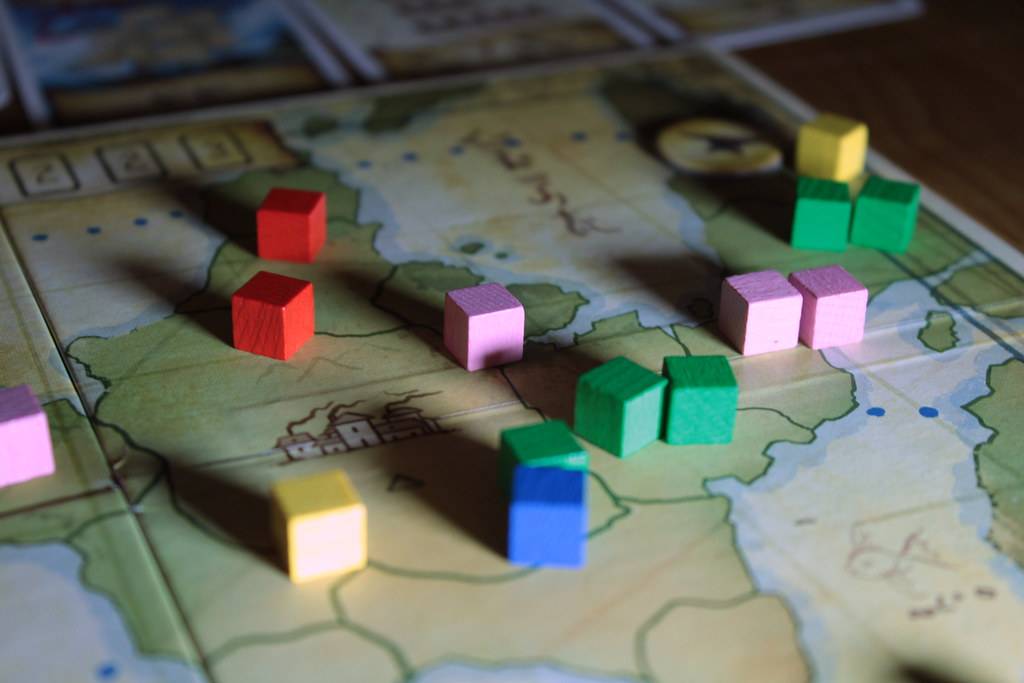
Risk diplomacy refers to a form of strategic interaction in international relations where state-like actors engage in calculated maneuvers, alliances, and confrontations under conditions of uncertainty and competition. Drawing on game-based simulations such as the board game Risk, this concept emphasizes the dynamics of power balancing, deterrence, and strategic cooperation within a zero-sum environment. As Michael P. Marks (2007) illustrates, such simulations allow students and scholars to explore core theoretical frameworks—including realism, alliance theory, and security dilemmas—through experiential learning. Risk diplomacy thus embodies the intersection of decision-making under pressure and the pursuit of strategic advantage in an anarchic international system.
- Marks, M. P. (2007). Using the Game of Risk to Teach International Relations. PS: Political Science and Politics, 40(4), 757–762. https://www.jstor.org/stable/44235311
- Tarrant, R. (2016, September 12). Using board games to teach Global Politics [Blog post]. tutor2u. https://www.tutor2u.net/politics/blog/using-board-games-to-teach-global-politics
- Times Higher Education. (2024). Use gamification to teach complex international relations concepts. https://www.timeshighereducation.com/news/use-gamification-teach-complex-international-relations-concepts
- Conrad, J. (2019). Teaching guide for Gambling and War: Risk, reward, and chance in international conflict. University of North Carolina at Charlotte.
- Houser, D., & McCabe, K. A. (1998). Risk and uncertainty in international relations: An experimental approach. Games and Economic Behavior, 23(1), 165–190. https://doi.org/10.1006/game.1997.0610

Leave a comment