

Written by Anjana Sinha Kumar
Anjana Sinha Kumar is originally from India and is currently pursuing Ph.D. in International Relations at the University of Warsaw. Her research focuses on refugee and migration studies, with a particular interest in the intersections of populism, displacement, and humanitarian governance. She has previously authored a thesis titled “India’s Treatment of Rohingya Refugees: Humanitarian Commitment Amidst Global South Leadership,” showing her academic inclination towards refugee rights within the context of emerging global powers.
Her academic work is mainly in critical engagement with the Global South, and she continues to investigate the political narratives and policy frameworks surrounding refugee and asylum seekers in South Asia. Beyond her research, she is passionate about music and cinema and enjoys spending time with her beloved furry friend- June.
Abstract
India has historically upheld a tradition of providing refuge to displaced populations, thus demonstrating a commitment to secularism and humanitarian principles. However, the rise of Hindutva, a Hindu nationalist ideology, has significantly reshaped the country’s asylum policies, particularly in relation to Muslim asylum seekers and refugees. This article examines the growing influence of Hindutva on India’s asylum framework, highlighting its role in institutionalising religious discrimination, mainly through the Citizenship Amendment Act (CAA) of 2019. The article draws on constructivist international relations theory and explores how India’s national identity has been reshaped by religious and ideological influences thus excluding Muslim asylum seekers. The research further analyses the legal, socio-political, and international ramifications of India’s evolving refugee policies, emphasising the contradiction between its constitutional secularism and current asylum practices. The article argues that Hindutva-driven asylum policies not only undermine India’s historical humanitarian ethos but also challenge its commitments to international refugee norms. The article concludes by advocating for comprehensive legal reforms to restore India’s adherence to secular and humanitarian principles, ensuring equitable treatment of all asylum seekers, regardless of religious affiliation.
Introduction
India is often regarded as a refuge for those escaping persecution, serving as a safe haven for several refugee groups and displaced individuals. These includes Tibetans, Tamils from Sri Lanka, partition refugees from erstwhile East and West Pakistan, Chakmas from Bangladesh, Bhutanese refugees from Nepal, ‘Hindu, Muslims & Sikh refugees’ from Afghanistan, Rohingya refugees from Myanmar and also refugees from Somalia, the Democratic Republic of Congo (DRC) and Sudan.
This tradition of welcoming refugees reflects India’s commitment to pluralism and secular values. However, the rise of Hindutva, a political ideology emphasising India as a Hindu-centric nation, has led to a significant shift in its asylum policies. Religious identity now appears to overshadow humanitarian needs, with Muslim refugees such as the Rohingyas facing increasing hostility (Chimni, 1998; Beri, 2021).Despite having a large group of asylum seekers and refugees, India lacks a comprehensive legal framework to govern refugee protection. It is neither a signatory to the 1951 Refugee Convention nor its 1967 Protocol, leaving refugee governance to fragmented administrative policies. Tibetans and Tamil refugees, for example, receive direct government support, while others like the Rohingyas rely on organisations such as the United Nations HighCommissioner for Refugees (UNHCR) for recognition and aid (Vijayaraghavan, 2020). This “strategic ambiguity,” as refugee law scholar B. S. Chimni (1998) describes, allows India to selectively address refugee issues based on political, strategic, and ideological considerations.
The rise of Hindutva has exacerbated this selective approach, with religion becoming a determining factor in asylum policies. The enactment of the Citizenship Amendment Act (CAA) in 2019 exemplifies this shift. The CAA fast-tracks citizenship for non-Muslim refugees from Afghanistan, Pakistan, and Bangladesh, effectively institutionalising religious identity as a key determinant of asylum eligibility. Muslim refugees, particularly the Rohingyas, remain excluded and vulnerable under this framework (Friedberg, 2020). This move has been widely criticised, with the United Nations special rapporteur on minorities calling it discriminatory and in violation of international human rights standards (United Nations, 2019).
These policy changes align with the rise of the Bharatiya Janta Party (BJP) and the growing influence of Hindutva ideology, which prioritises Hindu refugees while marginalising Muslim minorities. Critics argue that both the CAA and the proposed National Register of Citizens (NRC) reinforce exclusionary practices, further undermining India’s secular constitution and its long- standing tradition of religious pluralism (Chimni, 1998; Friedberg, 2020).
The introduction of religion-based asylum policies represents a significant departure from India’s inclusive legacy of providing refuge to all regardless of religious background. While the government defends these policies as necessary for national security and preserving cultural identity, they have faced strong opposition from human rights organisations such as Amnesty International and the UNHCR (Nirmal, 2018). These shifts signal a broader transformation in India’s asylum policy, where Hindutva ideology now plays a central role, increasingly overshadowing humanitarian considerations.
Constructivist Analysis of India’s Asylum Policies
The International theory that explains the overshadowing of India’s commitment towards asylum by Hindutva is Constructivism. Constructivism explains how international politics is not solely driven by material factors like power or wealth but is also shaped by ideational structures, shared beliefs, identities, and norms created and maintained by social interaction. In this context, the rise of Hindutva in India presents a shift in the country’s approach to asylum, particularly in its treatment of the Muslim refugees, which reflects a growing prioritisation of religious identity over humanitarian considerations.
At the core of constructivism is the idea that state identity is socially constructed. States are not merely defined by their material characteristics like territory, military power, or economic capabilities but by their norms, beliefs, and the way they view themselves in relation to others. According to Alexander Wendt, “Anarchy is what states make of it,” meaning that the structure of international system is shaped by the identities and interests of states rather than an immutable, anarchic system. State behaviour, thus, is a result of these constructed identities, not just the pursuit of power (Wendt, 1992).
In the case of India, its identity as a secular and pluralistic democracy has always been foundation to its international and domestic image. Article 25 of the Indian Constitution embodies a secular framework, advocating equal treatment for all religions. This pluralistic identity allowed India to act as a refuge for a wide range of displaced communities. However, with the rise of the Hindutva ideology which has been championed by political groups such as the Bharatiya Janta Party and the Rashtriya Swayamsevak Sangh (RSS), this identity has increasingly been challenged. Hindutva, a political ideology that promotes India as a Hindu-centric state, aligns with the view that India is for Hindus, and that non-Hindu minorities, especially Muslims, should be marginalised (Savarkar, 1923). This shift in India’s identity is increasingly shaping its refugee and asylum policies, moving focus from humanitarian protection to one that considers religious identity as a determining factor in asylum eligibility.
Constructivism emphasises the importance of shared ideas and norms in shaping state behaviour, and this is particularly relevant when examining the impact of religion on India’s policies. The rise of Hindutva ideology has redefined India’s national interest, increasingly linking it to the protection and promotion of Hindu identity. This religiously charged nationalism has profound implications for India’s treatment of refugees. The CAA of 2019 is a key example of how the state has constructed its refugee policy in line with religious identity. The CAA grants citizenship to non-Muslim refugees from neighbouring countries, including Afghanistan, Pakistan, and Bangladesh, while explicitly excluding Muslims, including Rohingyas from Myanmar (Friedberg, 2020).
From a constructivist perspective, this shift can be understood as a product of the changing ideational structure in India. The rise of Hindutva, combined with the historical and cultural context of India’s interactions with its neighbours, has reshaped how India views refugees. For example, the persecution of Muslims, including the Rohingyas in Myanmar, resonates with India’s growing anti- Muslim rhetoric, leading to a reluctance to offer asylum to Muslim refugees. India’s relationship with Myanmar, shaped by shared cultural history and a common view on Muslim minorities, further complicates its response to the Rohingyas (Egreteau, 2003). Thus, the selective treatment of refugees is not merely a response to practical concerns but is deeply rooted in a constructed national identity that prioritises Hinduism over secularism or human rights.
Constructivism also emphasises the role of social norms in guiding state behaviour. As per the logicof appropriateness, states act in ways that are consistent with their identity and the norms they construct about what is acceptable behaviour. In the case of India, the rise of Hindutva has introduced new norms that prioritise the interests of the Hindu majority while marginalising Muslim minorities. These new norms are reflected in policies like the CAA and the National Register of Citizens (NRC), which use religious identity as a basis for granting citizenship and excluding Muslim refugees.
The logic of appropriateness in this context suggests that the Indian state is acting in a manner that aligns with the prevailing nationalist and religious norms, even if these norms contradict India’s historical commitment to secularism and its role as a haven for refugees. The exclusion of the Rohingyas and other Muslim refugees from the CAA is a direct result of these constructed norms, which view Muslims as “outsiders” to the Hindu-majority state, despite their vulnerability and need for protection.
The focus of Constructivism on the construction of identities and norms provides a useful lens to understand how India’s asylum policies have evolved under the influence of Hindutva. The country’s historical identity as a pluralistic democracy has been progressively reshaped by the rise of a religious nationalist agenda, which views asylum seekers through the prism of religious identity. While India once welcomed refugees based on humanitarian needs, the influence of Hindutva has led to a more selective approach that prioritises Hindus and marginalises Muslims. Methodology
Because of the contemporaneity of this topic, qualitative research methods have been selected, as it emphasises and describes the data. It also focuses on providing a comprehensive description and evaluation of the subject while emphasising and maintaining the significance of the research scope. However, through discussion and analysis, the research can become more multidimensional and extensive. The approach helps to answer as how religion is obliterating the country’s treatment of refugees and asylum seekers, ideologically. It involves a explorative review of existing literature.
The data is gathered from different secondary sources, including academic journals, scholarly articles, books, government reports, magazines, newspapers, seminar presentations, and conference papers. This actually ensures a rational understanding of the topic encompassing political, cultural, historical, religious and social dimension.
Hindutva and India’s Asylum Policy
The intersection of religion, nationality, and country of origin has become increasingly prominent in shaping asylum policies not just in India but worldwide. However, in India, the rise of Hindutva, a Hindu nationalist ideology, has significantly influenced the country’s approach to refugees and asylum seekers, particularly in its treatment of Muslim and minority populations. Historically, Indiahas always been known for its pluralistic ethos and commitment, but now it faces criticism for prioritising religious identity over humanitarian principles. Hindutva’s influence has not only redefined India’s asylum and refugee policies but has also established exclusionary practices, undermining the country’s constitutional commitment to secularism.
This meteorological rise can also be contributed to a broader pattern of religious nationalism in the global geopolitical landscape of the world. Across Asia, Islamophobia, amplified by right-wing ideologies, has played a significant role in shaping refugee policies. From the dominance of Buddhist Burmese nationalism in Myanmar to Han chauvinism in China and Hindutva in India, religious nationalism has emerged as a tool to manage diverse populations through fear and exclusion (Sharma, 2020). Hindutva, derived from the term “Hindu-ness,” seeks to establish a Hindu Rashtra (Hindu Nation), prioritising the interests of the Hindu majority while systematically marginalising non-Hindu communities. While India’s Constitution embodies secularism and guarantees equal rights to all, the growing dominance of Hindutva has undermined this foundation, intertwining religious identity with asylum eligibility.
The historical evolution of Hindutva politics is critical to understand its role in India politics and especially how it gradually influenced India’s refugee and asylum policy.The ideological foundations of Hindutva trace back to the early 20th century, with V.D. Savarkar providing its theoretical framework in his influential work Hindutva: Who is a Hindu? (Savarkar, 1923).
Savarkar argued that a true Hindu must identify with India as both their pitribhu (fatherland) and punyabhu (holy land). By this definition, Muslims and Christians, whose holy lands lie outside India, were excluded and categorised as “outsiders” (Ahmed, 2016). Actually, the Hindu ideology was articulated by Savarkar. His articulation of Hindutva was a response to the dual challenge of British rule and so called perceived threats from minority religions, particularly, Islam and Christianity. His concept was designed to promote a sense of pride in Hindu culture and its historical legacy, thus forging unity among all Hindus (Savarkar, 1923).This conceptualisation set the stage for a nationalist project rooted in the exclusion of religious minorities, portraying them as threats to the cultural and territorial unity of the nation.
Further, the institutionalisation of Hindutva ideology occurred with the founding of the Rashtriya Swayamsevak Sangh (RSS) in 1925, by K. B. Hedgewar. Further, Hedgewar was instrumental in operationalisation of Savarkar’s vision by building a cohesive and disciplined Hindu society. Therefore, RSS as an orgainisation engaged in different socio cultural activities, including organising social services, running schools, and promoting ideological and physical training among its members (Andersen & Damle, 2019).
Over time, the RSS expanded its influence through affiliated organisations, including the Bharatiya Janta Party and the Vishwa Hindu Parishad (VHP). These organisations collectively advanced the vision of a Hindu-centric India, often portraying minorities, particularly Muslims, as obstacles to national unity (Reddy, 2019). The present day BJP in particular arose as the main political arm of the hindutva movement, thus striving to transform ideological goals of RSS into policy and governance. Its ability to blend cultural nationalism with economic development agenda further established it hold among the voter base (Jaffrelot, 1998). In addition to this, the partition of India in 1947, which divided the subcontinent along religious lines, further established the anti-Muslim sentiment of Hindutva. The trauma of partition was weaponised by Hindutva proponents to portray Muslims as inherently disloyal and as adversaries of the Hindu majority.
The interplay of Hindutva and democratic governance has not just influenced India’s policies but also its societal dynamics and future. It has impacted the government’s stance on refugees and asylum seekers in a major way. This has made it very difficult for the country to balance its religious identity with its democratic value (Sharma, 2021).
Political mobilisation around Hindutva has frequently relied on the vilification of minorities. Key events such as the demolition of the ‘Babri Masjid’ in 1992, the Gujarat riots of 2002, and the enactment of the CAA) in 2019 exemplify this strategy. These incidents were not spontaneous; they were part of a calculated political agenda aimed at mobilising Hindu voters by stoking fears of Muslim “otherness” (Sanderson, 2015). The CAA, in particular, marks a critical moment, thus reflecting growing influence of Hindutva on India’s refugee policy. The Act offers a defined way to citizenship for refugees from Afghanistan, Pakistan, and Bangladesh, but only if they belong to specific religious communities: Hindus, Sikhs, Buddhists, Jains, Parsis, and Christians. However, Muslims are totally excluded thus making it the first law in India to use religion as a criteria for citizenship. This exclusionary provision has led to widespread criticism, both within India and internationally, for violating the country’s secular principles and contradicting global norms on refugee protection (Shahin & Hasan, 2023).
The exclusion of Muslims from the CAA is symbolic of Hindutva’s broader project to redefine Indian identity. By framing Muslims as security threats and potential infiltrators, Hindutva discourse has legitimised their exclusion from the benefits of being an asylum seeker or citizenship.
This discriminatory approach of the Indian government is evident in its repeated attempts to link Rohingya refugees to terrorism, illegal migration, and major threats to national security, despite the absence of substantive evidence to support these claims (Ahmad, 2019). By framing the refugee crisis as a security threat, the government has justified repressive measures such as the detention and deportation of Rohingya refugees, even as they continue to face persecution in Myanmar.
The Rohingya crisis involving Muslim, highlights the contradictions in India’s approach to asylum under Hindutva influence. While the country has historically welcomed persecuted communities, its treatment of the Rohingyas is in stark contrasts with its humanitarian legacy. The government’s efforts to deport Rohingya refugees and deny them access to basic rights reflect a deliberate attempt to align asylum policies with the majoritarian goals of Hindutva (Boutie, 2021). This shift not only jeopardises the lives of vulnerable refugees but also undermines India’s standing as a global advocate for human rights.
The influence of Hindutva on India’s asylum policy extends much beyond domestic policies, thus impacting its stance both on regional and international refugee issues. As we know that South Asia, is home to around 3.6 million refugees but it still lacks a cohesive framework for refugee protection(UNHCR, 2023). Though regional efforts, such as the SAARC’s Kathmandu Declaration and the AALCO’s Bangkok Principles, have sought to address refugee issues, they have largely been ineffective due to the prioritisation of national security and religious identities over collective solutions. India’s Hindutva-driven policies have further contributed to this fragmentation, thus obstructing the development of a regional approach to asylum and refugee protection (Sharma, 2020).
This overbearing influence of Hindutva ideology on its asylum and refugee policies has far- reaching implications as it has cultivated an environment of xenophobia and exclusion, where minorities and refugees are increasingly viewed with extreme suspicion and hostility. Policies such as the National Register of Citizens (NRC) in Assam, which disproportionately target Muslim migrants, illustrate the discriminatory application of Hindutva principles (Talwar, 2000).
Regionally, India’s exclusionary policies have strained its relationships with neighbouring countries, particularly Bangladesh and Myanmar, while failing to address the root causes of forced migration. Further, this act of prioritising religious identity over humanitarian considerations by India is also affecting the global perception of India as it is losing its reputation as a defender of the oppressed and a champion of asylum. Not just this, but the exclusionary nature of policies like the CAA is further undermining constitutional commitment of India towards equality and non-discrimination and raising concerns about its adherence to international norms on refugee protection (Ahmed, 2016).This marginalisation of asylum seekers and refugees additionally increases the risk of radicalisation and extremism of the lot , as disenfranchised populations become more vulnerable to exploitation by extremist groups (Shahin & Hasan, 2023).
India requires a fundamental shift in its approach towards asylum seekers and refugees as to address the challenge posed by Hindutva. Legal reforms are necessary to ensure non-discriminatory treatment of refugees and align India’s policies with international standards. This includes repealing exclusionary provisions in the CAA and enacting comprehensive refugee legislation that upholds the principles of equality and secularism. Additionally, public awareness campaigns are essential to counter xenophobia and promote a more inclusive understanding of national identity. India stands ata critical juncture. It can either continue to prioritise religious nationalism at the expense of its humanitarian legacy or reaffirm its commitment to pluralism and inclusivity. By embracing the principles of justice, equality, and compassion, India has the opportunity to reclaim its role as a global leader in refugee protection and set an example for the region and the world.
India’s Refugee Policies: From Inclusion to Exclusion
The Hindutva philosophy, propagated by right-wing nationalist groups and embraced by the current BJP regime, emphasises the notion of India as a Hindu nation. This approach has widely been criticised for institutionalising religious discrimination, undermining India’s secular principles, and deviating from international refugee norms (Shahin & Hasan, 2023).
The exclusion of Muslims under the CAA symbolises how Hindutva ideology has shaped India’s refugee policies. It prioritises the narrative of protecting Hindus and other non-Muslim minorities while casting Muslim refugees, particularly the Rohingyas, as security threats and potential agents of radicalisation (Abrar, 2001). The government has frequently linked the presence of Rohingya Muslim to concerns over terrorism and illegal migration. This securitisation of the refugee discourse not only criminalises vulnerable populations but also legitimises their detention, deportation, and marginalisation (Sharma, 2020). The Rohingya Muslim crisis highlights the stark contrast between India’s historical openness and its current exclusionary practices. The country which prided itself on offering sanctuary to the persecuted, has now adopted measures to push back Rohingya refugees, detain them in camps, and repatriate them to Myanmar, despite the ongoing risk of violence and persecution they face there (Ahmed, 2016). This shift can be attributed to the rising influence of Hindutva, which perceives Muslim refugees not as victims deserving of protection but as outsiders who threaten the cultural and demographic fabric of the nation.
This ideological turn is not limited to the Rohingya crisis. The treatment of Afghan and Tibetan refugees also reflects a shift from India’s earlier inclusive approach. While these groups have historically been welcomed and even supported by the Indian state, recent years have seen a decline in the resources and opportunities extended to them. The prioritisation of Hindu refugees under the CAA further marginalises other groups, signalling a broader trend of exclusion influenced by Hindutva ideals (Reddy, 2019).
The rise of Hindutva has also fostered a domestic environment where political discourse around Muslim refugees has been dominated by narratives of illegal migration, security threats, and cultural invasion, often amplified by media and political rhetoric. This environment not only dehumanises refugee and asylum seekers but also justifies their exclusion and mistreatment. These developments illustrate how Hindutva ideology has transformed India’s refugee policies into tools of exclusion and discrimination.
To counter this trend, it is imperative to strengthen India’s refugee policies and reaffirm its commitment towards protection of asylum seekers. This requires total rejection of exclusionary practices rooted in Hindutva ideology and a return to the principles of inclusivity and compassion that have historically defined India’s approach to refugees. Legal reforms are essential to ensure non-discriminatory treatment of refugees, including the enactment of comprehensive refugee legislation that aligns with international norms. Additionally, there is also an absolute need to promote public awareness and counter xenophobic narratives so as to foster a more inclusive and humane approach to asylum (Talwar, 2000).
India is standing at the crossroads whether it can either continue on the path of exclusion and discrimination, driven by Hindutva ideology, or reclaim its legacy as a refuge for the oppressed and a beacon of humanitarian values. The choice it makes will not only shape the lives of millions of refugees but also define its identity as a nation and its role in the international community. By embracing the principles of equality, justice, and humanity, India can reaffirm its commitment to asylum and set an example for the region and the world.
Socio-Political and Legal Consequences of Hindutva’s Asylum Policies
From a socio-political perspective, the asylum policy being promoted/followed by Hindutva not only excludes but discriminates against Muslim refugees. Since the territorial division of British India in 1947, migration policies have been shaped by religious lines. Hindu and Sikh refugees were generally welcomed and integrated into Indian society, whereas Muslim refugees were frequently branded as “illegal migrants” or “internal enemies” (Datta, 2021). This religious discrimination continues today, with Hindutva-affiliated organisations such as the Rashtriya Swayamsevak Sangh (RSS) extending support to Hindu refugees while excluding Muslim asylum seekers (Basu, 2019).
This has also resulted in an exponential rise in Islamophobia and anti-Muslim sentiments in public discourse. The BJP government and affiliated groups have actively used rhetoric to portray Muslims as a demographic threat to India’s Hindu identity (Jaffrelot, 2021). The mainstream Indian media also plays crucial role has in exasperating the problem by branding Muslim refugees as extremists linked to terrorist organisations (Siddiqui, 2020). This narrative fuels hostility against refugees and contributes to increasing communal polarisation.
There is tremendous legal implications of India’s Hindutva influenced asylum policy as it raises concerns about India’s adherence to international refugee norms. India is not a signatory to the 1951 Refugee Convention or its 1967 Protocol, which means it lacks a structured legal framework for refugee protection (Chimni, 2000). However, it remains bound by other international human rights obligations, such as the International Covenant on Civil and Political Rights (ICCPR) and theConvention Against Torture (CAT), which prohibit discrimination and forced deportations(UNHCR, 1966). The Indian government’s policies towards Rohingyas, including their detention, denial of basic services, and forced deportation—have been widely criticised by international human rights organisations, highlighting contradictions between India’s domestic policies and its global human rights commitments (Amnesty International, 2019).
India’s courts have occasionally intervened in refugee matters, recognising the right to life and dignity under Article 21 of the Indian Constitution as applicable to all individuals, including non- citizens (Supreme Court of India, 1996). However, the judiciary remains constrained by the absence of a comprehensive refugee law. While the Supreme Court has emphasised the principle of non- refoulement, the government has justified deportations under the Foreigners Act, 1946, which grants it broad discretion to remove any non-citizen (Bhattacharya, 2022). This legal ambiguity allows for selective enforcement, where Hindu refugees are provided legal pathways to stay, while Muslim refugees face detentions and deportations.
The introduction of the CAA further complicates the legal landscape. By explicitly excluding Muslims from its provisions, the Act violates India’s secular principles and raises questions about its compatibility with constitutional guarantees of equality under Article 14 (Mehta, 2020). The exclusion of Rohingyas and other Muslim asylum seekers from citizenship rights effectively renders them stateless, exposing them to further human rights violations. This has led to criticism from the United Nations, which has warned that the CAA, coupled with the National Register of Citizens (NRC), could create a humanitarian crisis by rendering large numbers of people stateless (United Nations, 2020).
Restoring India’s Commitment to Asylum and Refugee Rights
To reaffirm its historical role as a refuge for the persecuted and align its policies with international human rights standards, India must undertake comprehensive legal and policy reforms:
1. 2. Enacting a Comprehensive Refugee Law: India must establish a legal framework that guarantees non-discriminatory treatment of asylum seekers, replacing the current ad hoc policies that enable selective enforcement. A well-defined refugee law will provide clarity and protection to all asylum seekers, irrespective of religious identity (Chimni, 2000).
Ensuring Equal Treatment of Refugees: Asylum policies should be based on vulnerability and humanitarian need rather than religious affiliation. The exclusion of Muslim refugees from protection mechanisms violates India’s constitutional commitment to secularism and must be rectified through legislative reforms that ensure fair and just asylum procedures (Mehta, 2020).
3. Strengthening Regional and International Cooperation: India should collaborate with neighbouring countries and international organisations such as the UNHCR to develop sustainable refugee protection mechanisms in South Asia. Diplomatic engagement in addressing forced displacement—particularly in Myanmar—would enhance India’s role as a global humanitarian leader (Sharma, 2020).
4. Countering Xenophobia and Islamophobia: Civil society organisations, independent media, and legal institutions must work to dismantle the communal narratives that fuel hostility against refugees. Public awareness campaigns, policy advocacy, and inclusive governance can help foster a more tolerant and humane approach to asylum (Jaffrelot, 2021).
Case study-The Rohingya Refugee Crisis
The Rohingya crisis in India raises an epistemic questions about citizenship and statelessness. Despite Rohingyas arriving in India since the 1970s, they only gained public attention in 2012. In May of that year, between 3,000 and 4,000 members of the Rohingya community traveled to India’s capital, Delhi, to protest the United Nations High Commissioner for Refugees’ (UNHCR) refusal to recognise them as refugees. This demonstration occurred well before 2015 when the global community took notice of their plight, as many Rohingya perished at sea while fleeing persecution in Myanmar.
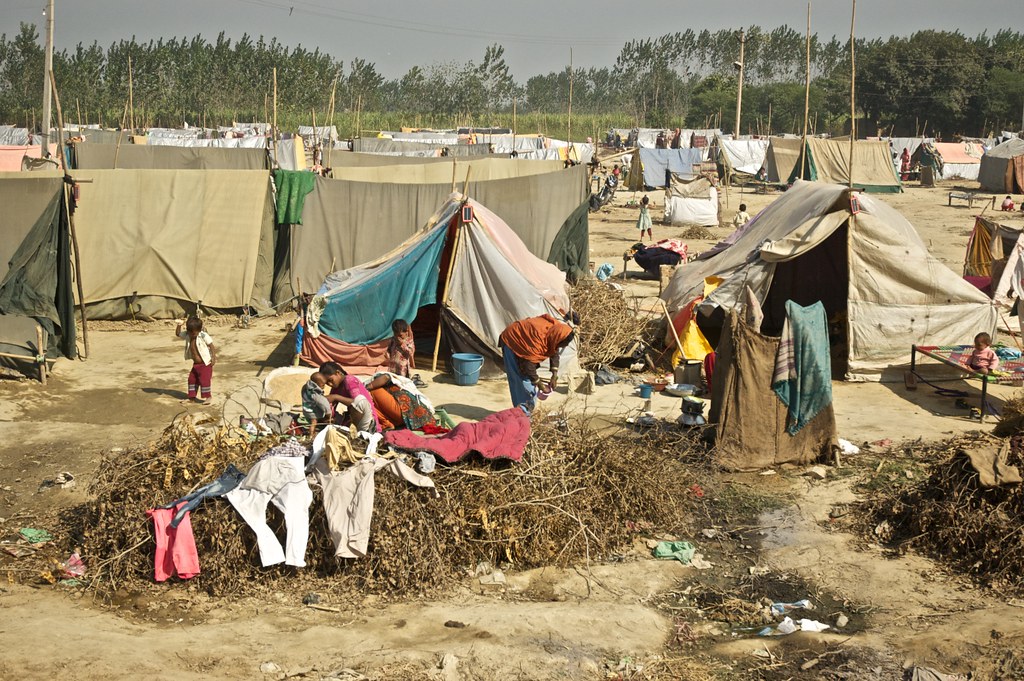
Despite being aware of their dire situation, the Indian government was reluctant to accommodate the Rohingyas, largely due to its shifting stance towards Muslim refugees. In 2018, seven Rohingyas were deported to Myanmar, followed by another family of five in 2019. These actions aligned with the policies of India’s far-right Hindu nationalist government, which has openly vowed to expel all Rohingyas from the country (Banerjee & Chaudhuri, 2022). Since 2017, the Indian government has vilified the Rohingyas, accusing them of terrorist links. Consequently, law enforcement and military interventions against them became more aggressive (Banerjee & Chaudhuri, 2022). The situation worsened as Rohingya women were forcibly separated from their children before incarceration, leaving them uncertain about their children’s whereabouts or if they would ever reunite. By 2020, amid the COVID-19 pandemic, a new wave of discrimination against the Rohingyas emerged. Hindu right-wing groups labeled Muslims as “Corona Bombs,” fuelling Islamophobic narratives. A TV news channel, TV9 Bharatvarsh, aired an investigative report alleging that Rohingya refugees had deliberately spread the virus by attending the ‘Tablighi Jamaat’ congregation at the ‘Markaz Mosque’ in Nizamuddin, Delhi, in March 2020. Such accusations intensified hostilities towards the Rohingyas, exacerbating their suffering. The nationwide lockdown imposed in 2020 left Rohingyas even more vulnerable. Living in overcrowded makeshift camps made social distancing impossible. Many lacked basic necessities such as face masks, soap, and hand sanitisers. Voluntary aid groups, which had previously supported them, struggled to provide food and essentials, leading to a humanitarian crisis (Banerjee & Chaudhuri, 2022). In oneRohingya settlement in Delhi, access to water was deliberately cut off in December 2019, further worsening their living conditions (Nazeer, 2020). The United Nations High Commissioner for Refugees (UNHCR) acknowledged its inability to adequately support the large number of refugees in India (Banerjee & Chaudhuri, 2022).
The Indian government has maintained a firm stance against the Rohingyas. In a significant statement before the Supreme Court, it asserted that Rohingya migrants lack the legal right to reside and settle in India, categorising them as illegal immigrants (ET, 2024). The government warned against judicial overreach in legislative matters, arguing that refugee status should not be granted to them. It further claimed that continued illegal migration by Rohingyas posed a national security threat, citing intelligence reports linking them to fraudulent identification activities, human trafficking, and other subversive actions. Consequently, many Rohingyas have been detained under the Foreigners Act (ET, 2024).
On July 2, 2024, the UN Committee on the Elimination of Racial Discrimination (CERD) called on India to cease the arbitrary detention of Rohingyas and refrain from forcibly deporting them, as doing so would expose them to severe human rights abuses, violating the principle of non- refoulement (Rahman, 2024). The committee condemned widespread hate speech against Rohingyas, urging the Indian government to investigate and penalise such rhetoric in compliance with its obligations under the International Convention on the Elimination of All Forms of Racial Discrimination. Additionally, CERD expressed concern over reports of mass detention without due process and inadequate detention conditions, including for children. It recommended that India ensure Rohingyas have access to employment, healthcare, and education by providing long-term visas and identity documents (UNHCR, 2024).While the Rohingya issue presents a complex socio- economic and security challenge with regional implications, India has yet to clarify its position. The Indian government is under pressure from multiple stakeholders, including the judiciary, opposition parties, civil society groups, and the international community (Dutta, 2017). While the Supreme Court and the International Court of Justice have advocated for a humanitarian approach, political groups and civil society factions demand a hardline stance. Given these conflicting viewpoints, the issue has grown increasingly complex. India must engage with both Bangladesh and Myanmar to develop a lasting political solution, considering their strategic importance in the region (Yhome, 2014). As a regional power and aspiring global leader, India bears a moral responsibility to facilitate a resolution (Hindu, 2022). The Rohingyas are deeply embedded within India’s national security discourse, officially labeled as “illegal immigrants” and “threats” to justify their deportation. The characterisation of Rohingyas as threats has been weaponised to further discrimination against them based on religion, xenophobia, and majoritarian politics. This became particularly evident during the NRC-CAA protests, whenthey were forced to remain confined to their camps due to their religious identity, leaving them vulnerable with no legal recognition or agency.Thus, the handling of the Rohingya refugee crisis by India, highlights divergence between its actions and obligations. Despite it being not signatory to the 1951 Refugee Convention or its 1967 Protocol, it remains bound by various other international human rights instruments such as the International Covenant on Civil and Political Rights and the Convention Against Torture, which requires it to protect refugees and asylum seekers, including the Rohingyas. But its approach has been characterised by several restrictive measures such as the deportation of Rohingyas, denial of access to basic services, and extreme hostility. This behaviour is also in stark contradiction to the key principles of International Law like non-refoulement and non- discrimination.
Conclusion
India’s historical commitment to providing asylum to persecuted communities has long been a reflection of its secular and humanitarian ethos. However, the rise of Hindutva as a dominant ideological force has significantly altered the country’s asylum policies, shifting them from an inclusive and humanitarian approach to an exclusionary and religion-based framework. The institutionalisation of Hindutva-driven policies, particularly through the Citizenship Amendment Act (CAA) and the proposed National Register of Citizens (NRC), has marginalised Muslim refugees, challenging India’s constitutional secularism and its adherence to international refugee norms.The constructivist analysis of India’s asylum policies highlights how the nation’s identity has been reshaped to prioritise religious nationalism over humanitarian principles. While India once prided itself on being a refuge for displaced communities, the growing influence of Hindutva has eroded this legacy, fostering an environment of discrimination and exclusion. The Rohingya crisis serves as a stark example of this shift, where Muslim refugees have been systematically vilified, denied basic rights, and subjected to deportation under the pretext of national security. The securitisation of refugee discourse, particularly in the case of Rohingya Muslims, has legitimised policies that contradict India’s obligations under international human rights conventions.
The socio-political consequences of Hindutva’s asylum policies are far-reaching. The rise of religious nationalism has intensified Islamophobia, deepened communal divisions, and legitimised exclusionary practices against Muslim refugees. The portrayal of Muslim asylum seekers as security threats has further fuelled hostility, both at the governmental level and within civil society. The media’s complicity in amplifying these narratives has reinforced discriminatory attitudes, making it even more difficult for Muslim refugees to find protection and dignity within India’s borders. Moreover, the prioritisation of Hindu refugees under the CAA underscores the selective application of asylum policies, favouring certain communities while disregarding others in need.
From a legal standpoint, India’s current asylum framework is marked by ambiguity and selective enforcement. The absence of a comprehensive refugee law has allowed successive governments to adopt ad hoc policies that serve political and ideological interests. While India is not a signatory to the 1951 Refugee Convention, it remains bound by international human rights obligations that prohibit discrimination and forced deportation. However, the government’s treatment of Rohingya refugees—ranging from detention and denial of services to forced deportations—raises serious concerns about its commitment to these principles. The CAA’s explicit exclusion of Muslims not only violates India’s secular framework but also risks creating stateless populations, further exacerbating human rights challenges.
The impact of Hindutva’s asylum policies extends beyond India’s borders, influencing regional geopolitics and refugee management in South Asia. India’s reluctance to engage in a cooperative regional approach to refugee protection has hindered efforts to develop a sustainable framework for addressing forced displacement. Its strained relationships with neighbouring countries such as Bangladesh and Myanmar highlight the consequences of prioritising religious identity over diplomatic and humanitarian considerations. By aligning its asylum policies with Hindutva ideology, India risks isolating itself from the broader international community and undermining its role as a global advocate for refugee rights.To restore its humanitarian legacy, India must undertake significant legal and policy reforms. The enactment of a comprehensive refugee law is essential to ensure the fair and non-discriminatory treatment of asylum seekers, regardless of religious affiliation. The repeal or amendment of exclusionary provisions in the CAA would help align India’s asylum policies with its constitutional commitment to secularism and equality. Additionally, strengthening regional and international cooperation in refugee protection would enhance India’s standing as a responsible global actor.
Public awareness campaigns and policy advocacy are also crucial in countering xenophobic and Islamophobic narratives that fuel hostility against refugees. Civil society organisations, independent media, and legal institutions must work collaboratively to promote an inclusive national identity that upholds the values of justice, compassion, and human rights. Without such efforts, the continued influence of Hindutva on India’s asylum policies will not only erode the country’s secular foundation but also compromise its commitment to global human rights norms. India stands at a critical juncture. It can either continue to pursue policies rooted in religious nationalism, thereby further alienating persecuted communities and damaging its international reputation, or it can reaffirm its historical role as a refuge for the oppressed by embracing a more inclusive and humanitarian approach. The choice it makes will define its legacy as a nation and determine its credibility as a champion of justice, equality, and human rights. By recommitting to its constitutional and humanitarian values, India has the opportunity to set a positive precedent for refugee protection, both within its borders and on the global stage.

- Abrar, C. R. (2001). Refugees in South Asia: A Regional Overview. Refugee Watch, 13, 5–20. Ahmad, I. (2019). The Rohingya crisis and India’s policy of exclusion. Journal of South Asian Studies, 42(3), 345–360.
- Ahmed, H. (2016). Hindutva and the politics of exclusion in India. Oxford University Press.
- Amnesty International. (2019). India: The illegal deportation of Rohingya refugees. Amnesty International Reports.
- Basu, P. (2019). Hindu nationalism and refugee policies in India: An ideological analysis. Asian Politics and Policy, 11(2), 220–237.
- Beri, R. (2021). Religious nationalism and refugee policy in India: The case of the CAA. South Asia Journal of Human Rights, 18(1), 67–89.
- Bhattacharya, S. (2022). Legal implications of the Citizenship Amendment Act. Indian Journal of Constitutional Law, 14(1), 77–94.
- Boutie, E. (2021). The rise of Hindutva and the marginalisation of Muslim refugees in India.
- International Review of Refugee Studies, 29(3), 303–322.
- Chimni, B. S. (1998). The geopolitics of refugee studies: A view from the South. Journal of Refugee Studies, 11(4), 350–374.
- Chimni, B. S. (2000). International refugee law and policy: A critical introduction. Cambridge University Press.
- Datta, A. (2021). Historical migration patterns and the institutionalisation of religious discrimination in India. South Asian Studies Review, 35(2), 98–114.
- Egreteau, R. (2003). India and Myanmar relations: The case of the Rohingya refugees. Asian Affairs, 34(1), 52–75.
- Friedberg, A. (2020). The CAA and its implications for India’s refugee policies. Georgetown University Press.
- Jaffrelot, C. (2021). Modi’s India: Hindu nationalism and the rise of ethnic democracy. Princeton University Press.
- Mehta, P. B. (2020). The constitutional implications of the Citizenship Amendment Act. Indian Journal of Public Affairs, 12(4), 211–229.
- Nirmal, B. C. (2018). India’s refugee policy and international obligations. Routledge.
- Reddy, P. (2019). The RSS and the politics of exclusion: A historical perspective. Modern Asian Studies, 53(3), 560–582.
- Sanderson, K. (2015). The rise of religious nationalism in India: Implications for minority communities. Oxford University Press.
- Savarkar, V. D. (1923). Hindutva: Who is a Hindu? Veer Savarkar Prakashan.Shahin, M., & Hasan,
- R. (2023). The securitisation of asylum in India: Hindutva and the legal framework. South Asia Human Rights Review, 25(1), 110–130.
- Sharma, A. (2020). Religious nationalism and refugee policies in South Asia. Cambridge University Press.
- Siddiqui, H. (2020). Islamophobia and media narratives on refugees in India. Media, Culture & Society, 42(6), 990–1012.
- Talwar, R. (2000). The NRC and its impact on Indian democracy. Contemporary South Asian Politics, 8(3), 178–192.
- United Nations. (2019). Report of the Special Rapporteur on Minority Issues: India’s Citizenship Amendment Act. UN Human Rights Council.
- United Nations. (2020). The impact of exclusionary citizenship laws in South Asia. UNHCR Reports.
- UNHCR. (1966). International Covenant on Civil and Political Rights (ICCPR).
- United Nations High Commissioner for Refugees.UNHCR. (2023). South Asia: Refugee statistics and protection challenges. United Nations High Commissioner for Refugees.
- Vijayaraghavan, V. (2020). The legal status of refugees in India: A study of the policy framework. Indian Journal of International Law, 59(2), 215–240.
- Wendt, A. (1992). Anarchy is what states make of it: The social construction of power politics. International Organization, 46(2), 391–425.

Leave a comment