
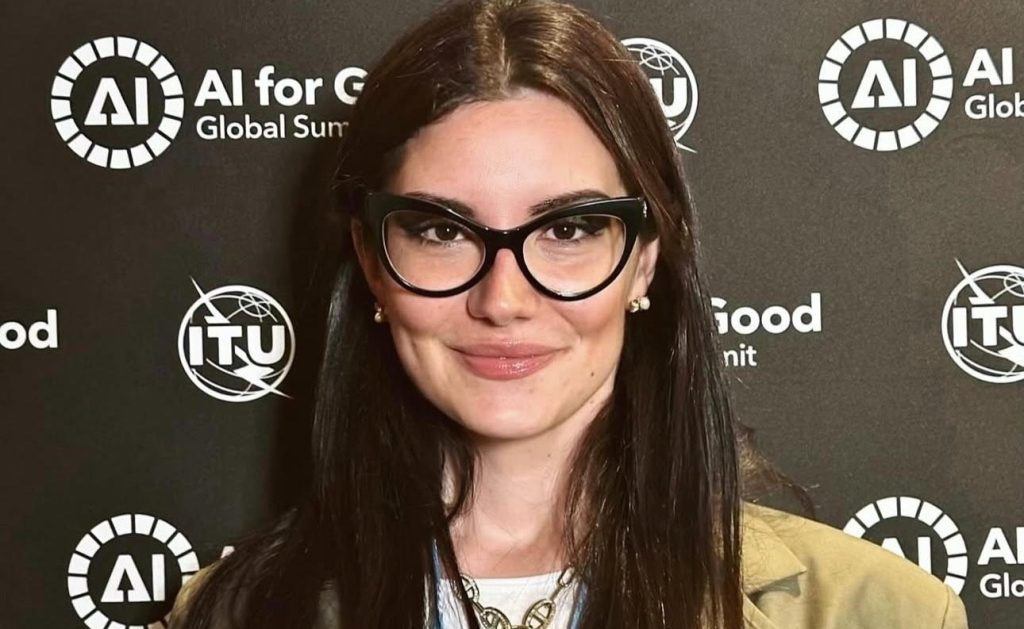
Interview with Maria Sara Neri
Maria Sara Neri is a Human Rights advocate passionate about the intersection of law and new technologies, especially AI-related law. Her journey began in 2020 during her second year of university, when she took the “Technological Innovation and Law” course at the European Center of Law, Science, and New Technologies (ECLT), which sparked her curiosity about the interplay between law, technology, and society. She is currently conducting research for her Master’s thesis in Law on the relationship between Fundamental Rights and AI within International and Comparative Law, with a focus on EU law. She believes in the transformative potential of AI, but also considers it urgent to reinterpret Human Rights and democratic values in a new light, since—just as throughout human history—also the digital sphere is a battleground between democracies and autocracies.
Question 1: What inspired you to pursue a career in international law? What was the biggest factor that led you into this field? Which events have motivated you the most along the way?
Well, the reasons are many, and I don’t like to oversimplify, but maybe the real reasons trace back to my actual roots. I was born in Mozambique (Africa) and spent my early years surrounded by real poverty before moving to and growing up in Italy. I guess that this “duality” of witnessing hardship firsthand while experiencing privilege has profoundly shaped my DNA and the way I perceive what surrounds me. I’ve always had this deep passion for traveling, not just for exploring but for understanding and embracing diversity, which, to me, is really the starting point of any real connection between people. Aside from this, I gradually became more and more aware of how arbitrary privilege can be, realizing a simple fact: what did I —or any of us— do to be born in the ‘right’ part of the globe? And those who can’t even afford a daily dish of rice, what did they do ‘wrong’ to deserve such hardship? Nothing. Both cases.
Two particular experiences really left a mark on me: one in India and the other in Palestine, where I spent time volunteering in orphanages with children who, for me, represent the best part of humanity. In both places, the children had been abandoned or were born into unimaginable situations, the kind that are honestly too painful to even put into words now. Still, these two experiences changed my perspective, and they truly changed me as a person. When I got back home, I really struggled to recognize myself because, sure, we all know you never come back the same after a trip like that, but that level of detachment was just too much for me. I won’t hesitate to say that coming back home marked the start of a kind of existential crisis—one that even led me to intensify my journey in therapy. Today, looking back and connecting the dots, it all makes sense, because “before the rainbow, there’s always a storm, right?”
It was during that period that everything just kind of click. By then, it was 2019, and I had to decide which university to attend. While wondering which academic path would actually connect with what I had felt during those trips, (international) law entered the picture. Actually, this field of study brings together two core parts of me: the advocacy I carry out outside the university, and my academic journey. Both aim for the same goal: giving a voice to those who simply don’t have one and, actually, I dreamed of being a lawyer since I was little—my relatives still laugh about how, at eight years old, I used to spend afternoons sharing stories from books I loved while pretending to teach an imaginary class in my room (no doubt, Geronimo Stilton was always my go-to!). Because yeah, silence has never been an option for me.
I really believe that law is a powerful tool for defending the most vulnerable, those who are marginalized and discriminated against, and who often don’t have the means to stand up for themselves. Over these last six years in advocacy, I’ve realized that being a Human Rights advocate and the social role of a lawyer aren’t so different because, as I always say, they’re two sides of the same coin: amplifying voices that would otherwise go unheard. Whether I’m standing before a judge or addressing governments, the mission stays the same: to speak up for someone who simply can’t.
So, here we are.
Question 2: What have been the biggest challenges and advantages of working with institutions such as the United Nations, the European Union, and the Council of Europe and are these institutions effective in addressing today’s major global challenges?
One of the biggest challenges I’ve faced working in these environments is just being taken seriously as a young professional. So often, youth gets equated with inexperience, even when the issues on the table directly affect us as young people. It can be tough to have your contributions really valued (it’s a bit like what happens to women since most of the time, it’s men making decisions about our rights. Sounds familiar?).
There’s this general perception that we don’t have the expertise or authority, even when we’re bringing fresh perspectives and new ideas. And honestly, what people don’t always tell you is that it takes a lot of sticking with it, believing in yourself, and building up your experience before people start to take your input seriously. But on the bright side, one of the best things about working and volunteering with these institutions is the chance to actually be part of change, have meaningful conversations, and meet peers from all over the world. Some of these colleagues turn into great friends outside of work, and honestly, that’s probably the best part. On another note, it’s really empowering to see how these institutions encourage multilateral dialogue and tackle big issues like Human Rights, especially in a world that’s getting more and more polarized, even about things that should be obvious: our rights. Honestly, working on these issues gives you a bit of hope, even when the headlines make it seem like everything’s going downhill. So, I really believe these environments are still essential, and we desperately need new spaces and opportunities for real, constructive dialogue—the kind of conversation that seems to be missing from politics these days.
Question 3: What advice would you give to young professionals who aspire to collaborate with global institutions?
The first piece of advice that comes to mind is: only go into this career if you’re sure it’s what you really want, not because you’re not sure what else to do, or because you feel pressured to pick an academic path at any cost. I’m a big fan of taking some time for yourself, a gap year to figure out what you actually like and what really excites you (there are tons of projects out there that let young people volunteer and travel for free or at a low cost!). Like in many fields, this one takes a lot of dedication and, honestly, something people don’t talk about enough: it requires a LOT of volunteering, unpaid projects, and unpaid internships, especially at the beginning. However, embrace every chance to grow, whether that’s learning new languages, going to conferences, or applying for that opportunity you almost skipped because you thought, “Nah, they’ll never select me.”
Learn. Come back home inspired. Learn some more.
And, even when we’re working hard, I always remind myself that we need to practice patience. Sometimes it feels like the world is just racing ahead (toward what, I am not even sure. Making money? Turning capitalism into the backbone of every single interaction and relationship we have? Maybe) and, in any case, results don’t come fast. From my little experience, I’d say this is a field where you really have to be willing to put in the groundwork—what we call “gavetta” in Italy—before you reach the goals you dreamed about when you started university. So my advice is simple: if this is your dream, go for it, but “go big or go home”.
Question 4: What inspired you to take such a step as creating your own project and a platform like iGlobal.Lawyer to bring together topics such as Human Rights (Law), advocacy and innovation?
Living in the years where the Internet is a religion leads us to instinctively feel that this digital revolution isn’t just about changing our tools or how we do things, but about how it’s actually reshaping how we think, how society works, and even what it means to be human. The so-called digital transformation is clearly opening up new possibilities and breaking down old barriers, which is why it’s something people from all kinds of fields care about—from law and tech to philosophy and social sciences—and, right now, it’s incredibly important that we come together to create a kind of framework for a new digital democracy. A digital democracy that uses digital tech to make democracy stronger, get more people involved, and make sure no one’s left out. Part of that means figuring out how to protect and respect Human Rights in this digital world, building on the rights we already have and making sure they actually work online.
Artificial Intelligence is probably the biggest (and latest) example of this digital transformation and, while it might seem like the latest hot topic, it’s really been in the works for a long time. Calling machines “intelligent” has been a slow process, the result of decades of progress in computer science and tech, but what’s different now is that we have enough data, computing power, and language skills to make AI actually useful in everyday life.
Honestly, I started iGlobal.Lawyer because there just aren’t enough places that really dig into how Human Rights and technology are connected, and it’s a pretty complicated relationship. I’ve been involved in Human Rights advocacy since I was in high school, and as I went deeper into law during university, it became really clear how closely law and advocacy go hand in hand: law is the tool that makes advocacy’s core battles effective. I wanted to create a space where advocates could read real, insightful analysis from people who know their stuff and have real-world experience, but in a way that’s easy to understand not only for lawyers, law students, or techies. The world is changing fast, and we need to change how we talk about social issues like discrimination. It’s not just the old traditional stuff anymore: nowadays, discrimination could be a hidden algorithm deciding if you get called for a job interview or not and, sometimes, it’s not your CV holding you back, but the biases built into technology itself—the simple fact of being a woman can still work against you, even if you’re more qualified than the guy who gets picked instead of you!
So for me, iGlobal.Lawyer is about making these conversations open, honest, and relevant for everyone, because these issues affect all of us, every day. Especially advocates, who every day fight battles not for themselves, but for society, for others, need to concretely grasp what is happening to our rights, no matter whether they’re studying philosophy, sociology, history or any other (non-strictly-related-to-these-topics) field.
This interview was conducted by Uğur Can Özkan & Esma Akçiçek

Leave a comment