
Written by Oscar Bermudez
Oscar Bermudez was born in El Paso, Texas, and earned a degree in Economics with a minor in International Relations from Saint Louis University Madrid. He is currently pursuing a master’s degree in World Politics and International Relations at the University of Pavia and is set to graduate in April 2025. His thesis, titled; The Impact of the Turkish Language on Syrian Refugee Integration: Perceptions, Lived Experiences, and the Implications for Conflict Management, reflects his strong focus on migration and conflict studies. In 2024, he spent six months in Istanbul, conducting research on Syrian refugees, interning at the Istanbul Policy Center, and actively participating in workshops at Istanbul University on social cohesion and refugee integration. His academic and professional interests center on conflict management and migration in the Middle East. Proficient in Levantine Arabic, he closely follows regional developments.
Abstract
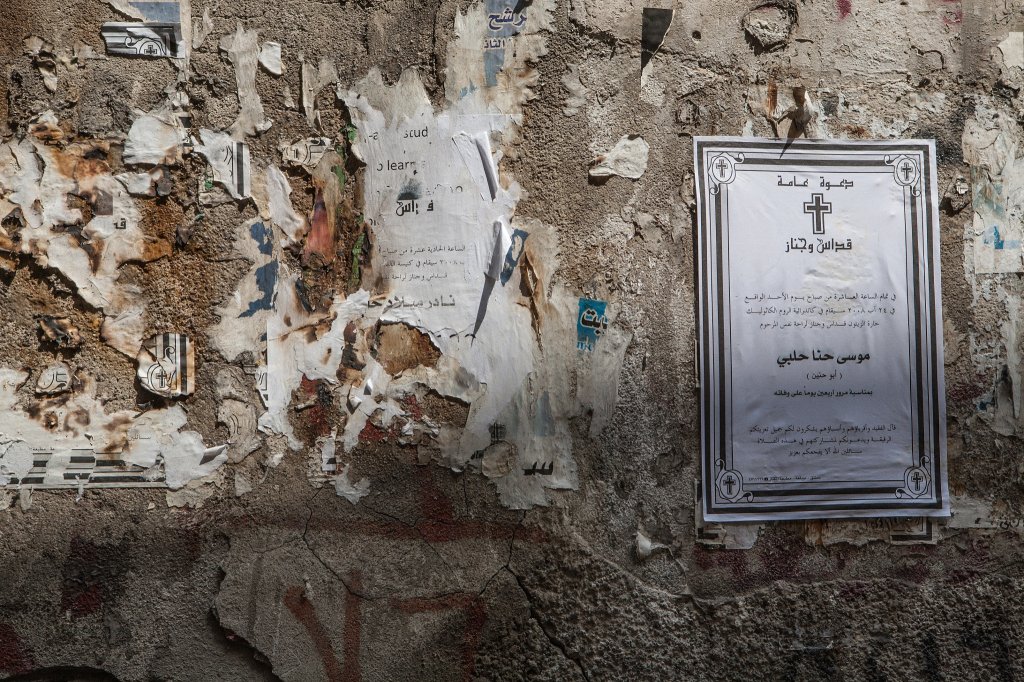
In Syria, outbreaks of violence in the northwest of the country have shocked the nation and the international community. Reports of massacres against Christians followed and began to circulate throughout the internet. However, the legitimacy of these claims soon began to come into question, raising concerns about the role misinformation plays in the new Syrian state. Three brief interviews with Syrian Christians—two residing in Syria and one in Europe—were conducted to gain a better understanding of the reality on the ground. Two Orthodox Christians, one from Wadi al-Nasara and the other, from Mashta al-Hilu, were residing in Syria. The other, a Catholic, still has all her family in Damascus, where she was raised. This article seeks to shed light on the challenges the Christian community faces amid the ongoing turmoil.
Outbreak of Violence
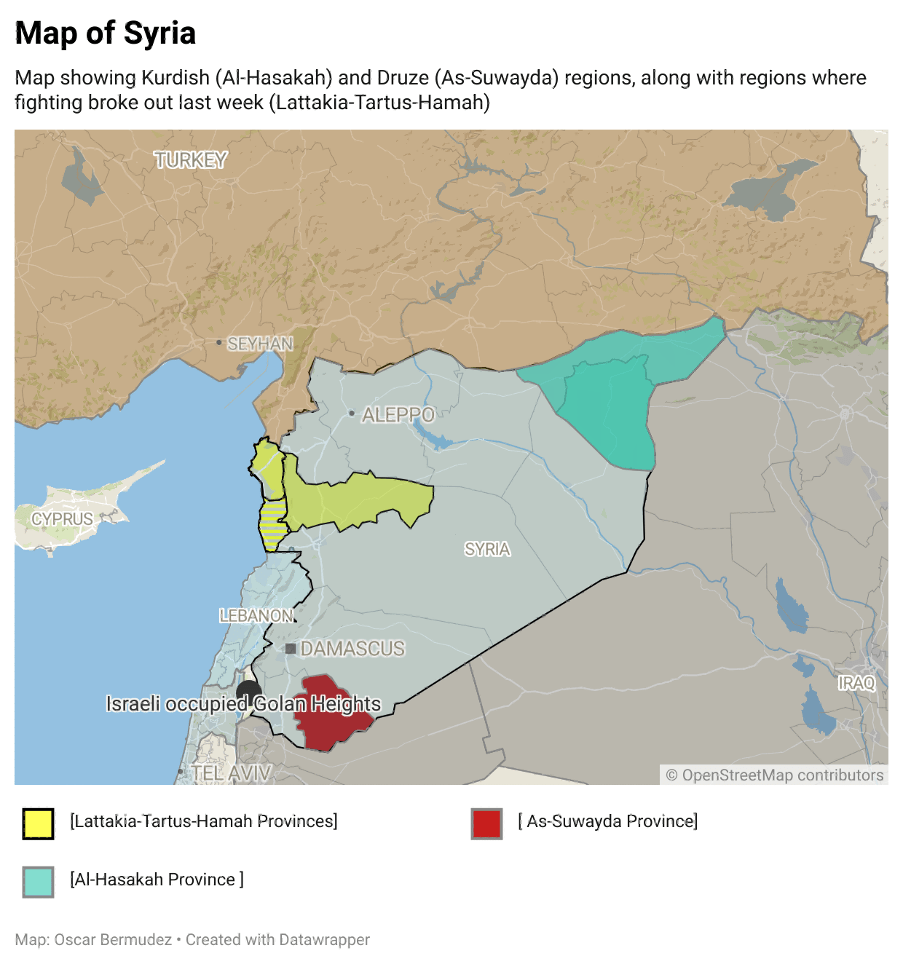
Last week saw the bloodiest outbreak of violence in Syria since the ending of the civil war last December. According to the Syrian Observatory for Human Rights, based in the UK, at least 973 civilians were killed in more than 20 locations across the provinces of Latakia, Tartus, and Hama. The observatory noted that most of the civilians killed were from the Alawite religious minority in the country.
Violent battles and a string of retaliatory killings that mostly targeted the Alawite group, to which Assad belongs, broke out last week after pro-regime elements loyal to the ousted president Bashar al-Assad assaulted a Syrian security patrol.
As of Monday, March 10, over 1,400 Alawite families, totalling over 6,000 people had arrived in Lebanon’s Akkar province, according to Governor Imad al-Labaki. The village of al-Massoudiyeh is currently sheltering at least 550 families, as reported by the village’s mayor, Ali al-Ali, to the Middle East Eye.
Reports of attacks on Christians
In the wake of the violence, social media was set ablaze with comments about the impending civil war in Syria and the massacres being committed against minorities, especially Christians. Taking to X, Secretary of State Marco Rubio condemned the violence, saying, “The United States stands with Syria’s religious and ethnic minorities, including its Christian, Druze, Alawite, and Kurdish communities.” Elon Musk followed by posting a 2015 video of Trump suggesting Assad was better for Syria with the title ‘Prophetic’. Many social media commentators, especially those on the political right, began to voice their concerns over the ‘killing’ of Christians.
While the attacks are undoubtedly tragic, there currently appears to be no evidence pointing towards Christians being targeted due to their faith. False rumours about Christians being persecuted are harmful for the Christian community. A communications officer for Open Doors in the Middle East and North Africa, an organization that supports persecuted Christians worldwide, said “I’m terribly worried by it (false rumors), because something like this can rebound onto the Christians there.”
The Response from the Church
Following the outbreak of clashes between Assad loyalists and militant groups tied to the new government, the Apostolic Vicariate of the Latin Community in Syria released a statement on Friday March 7, endorsing the Syrian government in its conflict with Assad regime loyalists.
The following day, the leaders of Syria’s Christian churches, Greek Orthodox Patriarch John X of Antioch, Syriac Orthodox Patriarch Mor Ignatius Aphrem II, and Melkite Greek Catholic Patriarch Youssef Absi, released a joint statement denouncing the recent surge of violence in the country, calling for an immediate cessation of the bloodshed and for a national reconciliation, saying, “It is essential to establish an environment that facilitates the transition to a state that respects all its citizens and lays the foundation for a society based on equal citizenship and genuine partnership, free from the logic of vengeance and exclusion.” The Patriarchs stressed the importance of sovereignty in national unity, and rejected attempts to try and further divide the country “We reaffirm the unity of Syrian territory and reject any attempts to divide it.”
The next day, in a united statement, Christian churches in Latakia urged people not to be influenced by rumours and to rely solely on official church sources. In a phone interview, Syrian Catholic Archbishop Jacques Mourad of Homs said “Christians were killed, not because they were Christians, but because they lived in Alawite neighborhoods. They were collateral victims.”. He estimated that around 12 Christians were killed during the fighting, adding that, “saying that the government is specifically targeting Christians is inaccurate and could put them at further risk.”
Christians in Syria
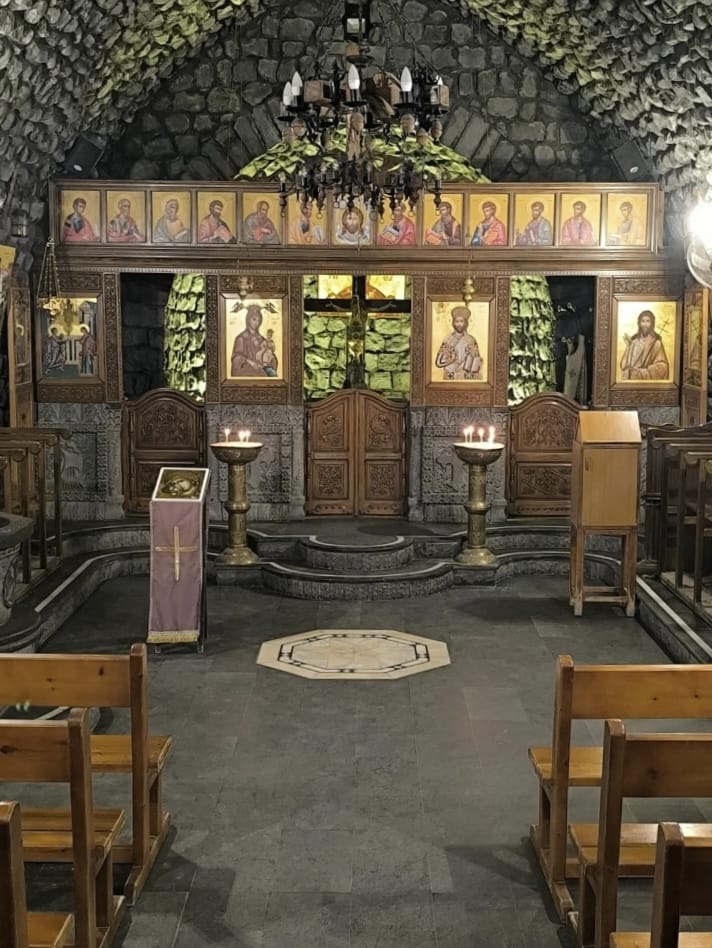
Syria is home to one of the oldest continuous Christian communities in the world. Saint Paul’s conversion in the Book of Acts took place on the road to Damascus, while the city of Antioch in northern Syria is home to one of the oldest Christian patriarchates and religious centers for the Church.
Today, if someone were to look up online the number of Christians in Syria, it might show the population at around ten percent; however, this number is misleading. According to Aid to the Church in Need, an international Catholic charity, the number of Christians in Syria today is less than 300,000. This represents a dramatic decline from the estimated 1.5 to 2 million Syrian Christians pre-civil war.
While the Assad regime portrayed itself as the protector of religious minorities, placing a special emphasis on the role it played in protecting Christians, it was its brutal handling of the Syrian Civil War that saw the Christian population drop so dramatically. The Christian community, like the rest of Syria, was devastated by the civil war and its aftermath. Christians along with other minority groups were particularly vulnerable to extremist groups, leading to an exodus of large numbers of Christians. During the war, more than 120 churches and Christian places of worship were destroyed. The worsening living circumstances, lack of work and educational prospects, and rising expenses of basic commodities and services, combined with the continued conflict, were the primary causes of the exodus of many Christians from Syria.
Post Assad
With the fall of Assad, Syrian Christians remain in a sort of limbo, many feel a mixed sense of optimism and fear. Father Firas Lutfi, the Latin-rite parish priest of Damascus, who described the fall of the regime as “a gift that comes to us on the feast day of Mary: the birth of the new Syria after 53 years of a dictatorial and bloodthirsty government,” noted that Assad had left behind “more than half a million dead” and “an economy in ruins” and claimed that now was the moment to “celebrate Syria’s rebirth.”. Father Bajhat Karakach, a Franciscan friar and the Latin-rite parish priest of Aleppo, was asked by Vatican News why so many Christians are celebrating the regime’s overthrow, responding “Like all Syrians, Christians had been “completely exhausted by living under the regime”, where there was “no development, no economic growth.”
Perceptions from Syria’s Christian population
A woman from Masthta al-Hilu expressed a sense of optimism, stating, “I think the new government is good; the situation has significantly improved; prices are declining, electricity is returning, and the currency is stronger, I’m optimistic that things will improve; lifting the sanctions is what matters most to us.” When asked about the treatment of Christians under the new government, she said, “I think the new government treats Christians really well, there are a lot of rumors circulating, but Christians are doing well, nothing bad has happened to us.” She said the main threat to security was the foreign fighters; “al-Sharaa needs to get rid of them as soon as possible.”
In contrast to some reports of Christians being slaughtered at the hands of the new government, a man from Waddi al-Nasara said, “The new government is not to blame for what happened in Latakia; the attackers are not Syrians, and the militants were even battling the government army because the government was attempting to defend civilians.” He however, expressed that there is fear in the Christian community: “We have concerns, of course, that everything will be more Islamic, that we could live under Sharia law, and yes, we get scared occasionally; my mother is concerned that the militias would come and kill us all, but where I am, we are safe; this place is like a different planet; it is not Syria.” His deepest concern was the economy; however, “Where we are, services are not getting better, prices are not dropping, people are starving, we don’t have electricity, the situation is really terrible.”.
In Europe, a woman from Damascus shared her concerns about the rising sectarian tensions back home. “My family in Damascus is safe; no one has attacked the Christians, as far as I know, but my family and friends are afraid we don’t know what will happen in the future.” She added, “The comments from the internet and social media really scare me, people are crazy online, death threats and horrible things are being said, people become extremely sectarian online, some groups are being threatened with death, and even a charity posted pictures of Ramadan treats with the caption, ‘Alawites have the right to live in their graves,’ after the massacres in Lattakia.” “Most of all, we are very worried about the foreign fights here in Syria; I even heard al-Sharaa will grant them citizenship.”
While the recent violence in Syria was not targeted against Christians, this isn’t to say that there are no concerns for Christians in Syria. Many Christians, such as the ones interviewed in this article, expressed concerns about their safety and their future in Syria. Christian converts from Islam often face persecution and alienation from their families and communities. There remains the legacy of the Islamic State in the back of Christians’ minds and fears that extremist groups could remerge and once again target Christians. It is important, however, to stress the real concerns Christians have and to avoid creating false narratives that not only harm Syria’s Christians but also harm all of Syria’s ethnic and religious groups by impeding efforts to bring these communities together.
Further Notes
- On Monday, General Mazloum Abdi, head of the Kurdish-led Syrian Democratic Forces (SDF) met with Syrian President Sharaa to sign a historic deal. The deal will integrate SDF armed forces and institutions into the new government, hoping to merge the Kurdish part of Syria, comprising a quarter of the country, with the new Damascus government. The deal which hopes to go into effect by the end of the year, will hand over control of border checkpoints along with the vital oil and gas fields, Damascus so desperately needs.
- There are ongoing reports of negotiations between Druze representatives from Suwayda and the government in Damascus. The agreement would allow Syrian security forces access to Druze territory in southern Syria. Like the agreement with the SDF, it would integrate Suwayda’s population with the new government, allowing the Druze to enter into the government’s security and defence forces, while granting them government jobs.
- Syrian Foreign Minister Assad al-Shibani will be the first official Syrian state representative to attend the International Conference in Support of Syria in Brussels on March 17. This follows in the wake of the European Union lifting of select sanctions dealing with transport, energy, and banking in an EU effort to encourage democracy. President al-Sharaa is hoping his recent engagements with the US-backed SDF and the Druze will help lead to the lifting of US sanctions on Syria. In an interview with Reuters al-Sharaa said, “Syria has the task of establishing security after the chaos that has occurred, and this is closely linked to building the economy, which cannot be done except with lifting sanctions.”
- On Wednesday, Turkish Foreign Minister Hakan Fidan met with President al-Sharaa in Damascus, among their talks about the future of Syrian-Turkish relations, Hakan expressed the importance of expulsing Syria’s foreign fighters, saying, “There is no change in our expectations for the termination of terrorist activities in Syria, the disarmament of terrorists, and the expulsion of foreign terrorists from Syria.”
- On Thursday, al-Sharra signed a temporary constitution, expected to be in force for a transitional period of five years. However, the declaration was strongly condemned by the Syrian Democratic Council (SDC), the political branch of the Kurdish-led Syrian Democratic Forces (SDF), who warned that it concentrated too much authority in the hands of the president and did not reflect Syria’s diverse community. The Kurdish reaction to the constitution begs issues about whether the Druze and other minorities will embrace it.

- Abdo, H., Sewell, A., & Albam, O. (2025, March 11). Syrian Kurds celebrate deal with Damascus as coastal residents remain wary after violence. AP News. https://apnews.com/article/syria-sdf-agreement-deal-coast-civilians-killed-lebanon-3e7dcf5a6322670dceb29ee9094fdbac
- After Assad, Syria’s Christians hope for “rebirth” of country. Vatican News. (2024, December 9). https://www.vaticannews.va/en/church/news/2024-12/syrias-christians-cautiously-optimistic-fall-assad-government.html
- Al Jazeera. (2025b, February 24). EU suspends select Syria sanctions to encourage democratic development. Al Jazeera. https://www.aljazeera.com/news/2025/2/24/eu-suspends-select-syria-sanctions-to-encourage-democratic-development
- Al Jazeera. (2025d, March 13). Syria’s Al-Sharaa signs temporary constitution. https://www.aljazeera.com/news/2025/3/13/syrias-al-sharaa-signs-five-year-temporary-constitution
- Al Jazeera. (2025b, March 10). Syria’s Al-Sharaa vows to punish forces responsible for mass killings. Al Jazeera. https://www.aljazeera.com/news/2025/3/10/syrias-al-sharaa-vows-to-punish-forces-responsible-for-mass-killings
- Azahari, T., Stewart, P., & Al-Khalidi, S. (2025, March 12). US steered Syrian Kurds towards Damascus deal, sources say | Reuters. Reuters. https://www.reuters.com/world/middle-east/us-nudged-kurds-towards-damascus-deal-troop-presence-comes-into-focus-2025-03-12/
- Badendieck, R. (2025, March 14). Turkish top officials make sudden trip to Damascus after Syria’s deal with Kurdish-led Group. AP News. https://apnews.com/article/turkey-syria-al-sharaa-erdogan-fidan-defense-pilot-award-kurds-9eb0a377ef277cdce2a22611cd31bfe3
- Christians in Syria. Embrace the Middle East. (n.d.). https://embraceme.org/christians-in-syria
- Hassan, A., & Wesolowski, K. (2025, March 12). تتحقق: أخبار مزيفة حول أحداث العنف الأخيرة بسوريا . dw.com. https://www.dw.com/ar/dw-تتحقق-أخبار-مزيفة-حول-أحداث-العنف-الأخيرة-بسوريا/a-71886229?fbclid=IwY2xjawI-WQhleHRuA2FlbQIxMQABHTT1UNNCRRbkfFC2ghxc6zoxrerNzuNT95xWD_MBH-t4g58oSmht99YoYg_aem_nweJLdWYkuV86T6ISE_VPg&sfnsn=mo
- Khalil, A. (2025, January 28). Christians in Syria: A rich cultural heritage. Hawarnews. https://hawarnews.com/en/christians-in-syria-a-rich-cultural-heritage
- Luck, T. (2025, March 14). Syria hangs by a thread while US sanctions block reconstruction. Wilson Center. https://www.wilsoncenter.org/article/syria-hangs-thread-while-us-sanctions-block-reconstruction
- Misleading reports about “slaughter of Christians” could endanger Syrians, says open doors expert. Open Doors UK & Ireland. (2025, March 13). https://www.opendoorsuk.org/news/latest-news/syria-misleading-reports/
- The New Arab. (2025, March 10). Syrian Christian leaders deny claims of mass killings. The New Arab. https://www.newarab.com/news/syrian-christian-leaders-deny-claims-mass-killings
- The New Arab. (2025b, March 14). Syria’s Kurds reject “authoritarian” temporary constitution. The New Arab. https://www.newarab.com/news/syrias-kurds-reject-authoritarian-temporary-constitution
- Orthodox Times. (2025, March 9). Patriarchs of Syria condemn escalating violence, call for Peace and national reconciliation. Orthodox Times (en). https://orthodoxtimes.com/patriarchs-of-syria-condemn-escalating-violence-call-for-peace-and-national-reconciliation/
- Shakra, E. A. (2025, March 11). Why Syrian Druze have put their faith in Damascus instead of Israel for community’s Security | Arab News. Arab News. https://www.arabnews.com/node/2593272/middle-east
- Suleiman, A. H. (2025, March 11). سوريا: أوقفوا موجة القتل في الساحل واحموا المدنيين. Human Rights Watch. https://www.hrw.org/ar/news/2025/03/10/syria-end-coastal-killing-spree-protect-civilians
- Syrian alawis sheltering in Lebanon say it isn’t safe to return home. Middle East Eye. (2025, March 11). https://www.middleeasteye.net/news/syrian-alawis-sheltering-lebanon-isnt-safe-return-home
- U.S. Department of State. (2025, March 11). U.S. Department of State. https://www.state.gov/agreement-between-the-syrian-interim-authorities-and-the-syrian-democratic-forces/
- Zelin, A. Y. (n.d.). Syria’s transitional honeymoon is over after massacres and disinformation. The Washington Institute. https://www.washingtoninstitute.org/policy-analysis/syrias-transitional-honeymoon-over-after-massacres-and-disinformation

Leave a comment