

Written by Barbara Gregorczyk
Barbara Gregorczyk (born 2001) has been a working as a journalist for Polish Radio Nowy Świat since 2020. She covers foreign events and topics related to the environment and climate. She is the winner of the 10th edition of the Leopold Unger scholarship in 2022 for the best young journalists. This allowed her articles written in French to appear in the Belgian daily newspaper Le Soir. In 2023, she was Radio Nowy Świat’s correspondent at the European Parliament in Strasbourg. In 2024, she was a finalist for the “ Polish Student Nobel Prize” in the field of “Journalism and Literature.” In December 2024, she received a grant from the Balkan Invastigative Reporting Network to do a report on press freedom in Serbia.
Humanitarian crisis on the border between Poland and Belarus has been ongoing since 2021.1 2In fact, refugees, mainly from Iraq, Syria and Chechnya3, have been trying to get on the EU territory through that path since 2017 but their number wasn’t that high as in 2021. Between August and December 2021, tens of thousands of unauthorized border crossing attempts were recorded. Nowadays there are Afghans, Syrians, Ethiopians, Sudanese, Somalis, Iraqis and people from the wider Central African region trying to enter the EU through Belarus. While the route through the Mediterranean Sea is still the most common route taken by migrants including refugees to the EU since 2021, the popularity of route leading through the EU’s eastern border has been growing rapidly.4
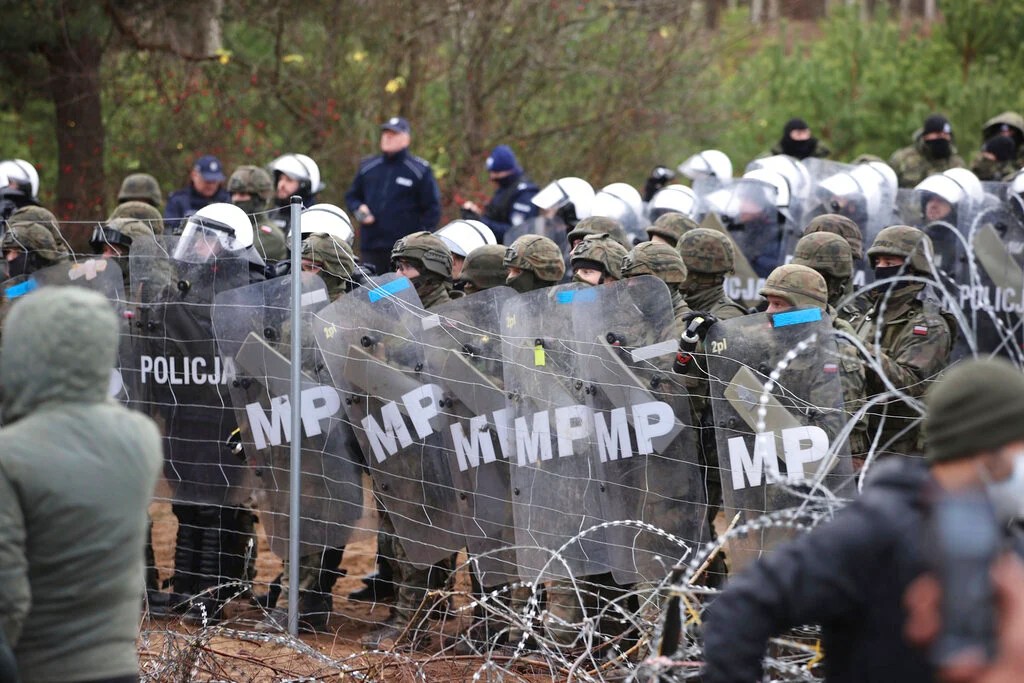
The Eastern European route is the only one that leads from Africa to the EU by land. For other routes, one has to choose the extremely dangerous journey across the sea, in a boat or on an overcrowded dinghy. The Missing Migrants Organization counted 31,124 migrants who went missing since 2014 during the crossing of the Mediterranean Sea5. However, the Eastern European route is also not easy. Poland, as a member state of the European Union, has an obligation to accept and process applications from people seeking international protection based on the Geneva Convention. However, this is not happening6. The Polish Border Guard applies “pushbacks” and, in violation of the Polish Constitution, deports people, including small children, back to Belarus7. Belarusian border guards, on the other hand, are known for their violence8. All patients of the “Granica” group, which provides humanitarian aid to migrants on the border strip, have experienced violence from the Belarusian border guards9. There are frequent incidents of rapes, thefts, severe beatings, and attacks by guardian border control’s dogs. Migrants are forced to enter rivers or crawl under fences under the threat of being murdered10. Cases of such violence from the Polish side are rarer, but they do occur. What is common from the Polish Border Guard are “pushbacks”, i.e., deporting people from Polish territory to Belarusian territory11. Importantly, Polish-Belarussian border, so called the “Green Border,” it’s one of the few remaining areas of virgin forests in the EU, which have rarely been touched by human hands. There is a virgin forest with numerous swamps, and wetland areas that are difficult for a person to cross. On October 29, 2021, the Polish Parliament passed the bill, considered in an expedited procedure, on the construction of border security, which, after being signed by President Andrzej Duda, came into effect on November 4, 2021. In June 2022, the Polish government officially completed the construction of a wall on the border with Belarus, which cost 615 million PLN. The construction of the wall did not end the crisis; people are still trying to cross it, and those who succeed and get caught by border control are often being sent back to Belarus. Since 2021, 22,696 people have applied for international protection at the Polish-Belarusian border, since that time 11,035 pushbacks have been recorded.12
In 2021, it emerged that people who are at the border were encouraged to migrate by Russian criminal groups. Information about migration opportunities, on Whatsapp, TikTok and other local social media in Africa and the Middle East, was posted by Russian smugglers13. They displayed themselves to people in crisis, people who have been persecuted by regimes or who have had to flee their country as a result of war. Flying their country is often the only resort for them. Desperate to-be migrants have to pay smugglers a sum of money that is unusually high for their financial means, so they sell their homes and possessions just to be able to migrate to the EU14. They are flying to Moscow or Minsk by plane, from where they are taken under the Belarussian-EU border. There they are disembarked and forced to cross the border. The European Union, as well as professors and scientists, saw this as a hybrid war undertaken in response to the worsening of relations between Belarus and the European Union following the 2020 presidential election in Belarus and the 2020-2021 protests in Belarus. Russia is probably trying to create a migration crisis and destabilize EU countries.
In 2023, on October 15, historic elections were held in Poland. The ruling party Law and Justice (PiS), considered center-right, on whose initiative the wall on Polish-Belarusian border was built, did not win a majority in parliament. The election was won by “Koalicja Obywatelska”, which is considered liberal-right and pro-EU. Its leader Donald Tusk, the current prime minister, vaguely criticized PiS’s actions on the border during the election campaign, explaining that the problem could be solved legally and with respect for human rights15. It was a hot topic in the public debate, the best Polish director Agnieszka Holland made a film about the situation on the border16, in which she describes, among other things, the true story of a woman from Congo in advanced pregnancy, who was thrown off a 2-meter high wall by the Polish authorities.17
In 2025, the humanitarian situation of people at the border still remains18. The government has not radically changed its approach to migrants trying to get across the Polish-Belarusian border, it has even tightened the PiS’s policy of previous years. On December 18, 2024, the government adopted an amendment to the law on stopping the attribution of international protection to foreigners. It provides for the possibility of temporarily suspending the acceptance of asylum applications. Human rights organizations including the UNHCR and the Helsinki Foundation for Human Rights are protesting against the bill. The HFPC points out the drawbacks of the proposed solutions:
“In the Foundation’s view, the proposed legislation is incompatible with the Polish Constitution and the standards of international law, contradicts EU law, both in force and pending with the EU Pact on Migration and Asylum, replicates the pattern of illegal pushbacks and heightens the risk of violating the prohibition on collective expulsion of foreigners under international law.” 19
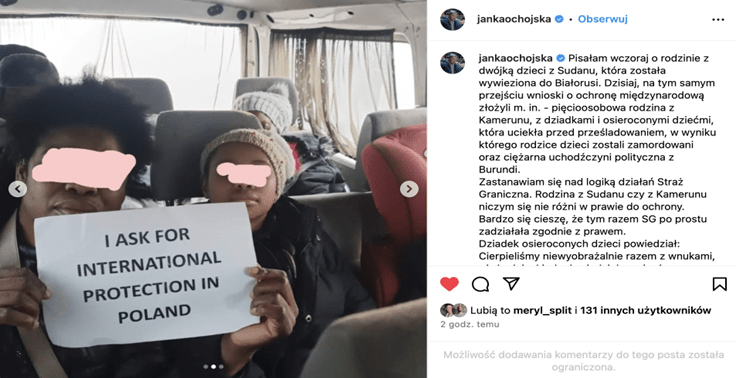
Janina Ochojska, founder of Polish Humanitarian Action (PAH) and an activist in her social media, published a photo of people including children who are asking for international protection in Poland, while border guards do not accept their requests. This is just one example of this type of conduct.
The PiS government was known for its liberal approach to the cutting down of Polish forests, which was repeatedly criticized by the current ruling coalition20. However, in December 2024, as “Oko Press” – a polish independent media outlet published an investigation that the current government led by Donald Tusk, under a law passed by the PiS party 3 years ago, cut as much as 172 km of the border strip next to the Bug River.21 This is an unprecedented logging, carried out on a virgin forest. Never before in the history of the Third Republic has anyone carried out degradation of nature on such a scale. All this to stop migrants from crossing the border. The problem, however, is that the section where the logging was carried out and where another dam and monitoring is to be built, was one of the tighter and the most securitized sections of the Polish border. Apart from the fact that several thousand cameras will be placed there, not much else is known. The investment did not have to undergo an environmental assessment, nor did it have to meet other requirements that are necessary for other installations. And this is under a speculative law, which was passed by PiS in 2021, and with the opposition of the current ruling coalition. Back in 2021, prof. Marcin Wiącek, an ombudsman pointed out the partial unconstitutionality of this legislation. Own due to the fact that the installations created under it do not have to meet most of the basic standards. The investment on the bank of the Bug river is about 270 million. The section where the cutting was carried out was one of the tighter ones on the Polish border with Belarus. As the portal Oko Press found out, on the cut 172-kilometer section of the Bug, less than 400 people tried to cross the border this year, all of whom were successfully stopped by the Polish border guard.
By January 7th 2025, 90 people had lost their lives at the border since August 202122.
- 1 „Setki migrantów gromadzą się na granicy polsko-białoruskiej” . Radio Wolna Europa/Radio Liberty . 8 November 2021.
- 2 Roth, Andrew (8 listopada 2021).„Białoruś eskortuje setki migrantów w kierunku granicy z Polską”. The Guardian . 8 November 2021.
- the Polish 3, F. P. (2019, June 13). The pushback of asylum seekers from the North Caucasus and Central Asia at the Polish border. The Foreign Policy Centre.
- 4 Arraf, J., & Peltier, E. (2021, November 13). Migrants Say Belarusians Took Them to E.U. Border and Supplied Wire Cutters. The New York Times.
- 5 International Organization for Migration. (2019). Missing Migrants Project. International Organization for Migration.
- 6 Human Rights Watch. (2021, November 24). Belarus/Poland: Abuse, Pushbacks At Border. Human Rights Watch.
- 7 Michał Rolecki. (2024, June 15). Pushbacki dzieci na granicy. Co to jest wiek kostny – i czy można na nim polegać? Oko.press; OKO.press.
- 8 Przemoc i push-backi na polsko-białoruskiej granicy. (2022, June 8). Human Rights Watch.
- 9 Grupa Granica na Instagramie: „Gaz pieprzowy w butelce wody” . (2020). Instagram.
- 10 Polska: brutalne pushbacki na granicy z Białorusią. (2024, December 10). Human Rights Watch.
- 11 Leading NGOs and Academics Denounce “Hungarian Border Hunter Model” | European Council on Refugees and Exiles (ECRE). (2023).
- 12 Granica, G. (12, August, 2024). „Chce zostac w Polsce 12-miesiecy nowego rządu w relacjach z granicy polsko-bialoruskiej
- Https://Wearemonitoring.org.pl/Wp-Content/Uploads/2024/12/Chce-Zostac-w-Polsce.-12-Miesiecy-Nowego-Rzad u-w-Relacjach-z-Granicy-Polsko-Bialoruskiej-1.Pdf.
- 13 Przemytnicy migrantów reklamują się na TikToku. Serwis stał się narzędziem przestępców od Łukaszenki | Niezalezna.pl. (2023). @Niezaleznapl.
- 14 Redaktor Bankier.pl. (2023, October 7). Lukratywny biznes: przemyt nielegalnych migrantów do UE wart krocie. Bankier.pl.
- 15 Chrzczonowicz, M. (2024, May 11). Donald Tusk: push-back humanitaryzmu. Z granicy z Białorusią zniknęli ludzie, została tylko wojna. Oko.press; OKO.press.
- 16 FilmPolski.pl . (2024). FilmPolski.
- 17 Judith z Konga: „Polscy pogranicznicy rzucili mną przez granicę. Nad drutem. Dwa dni potem poroniłam”. (n.d.). Oko.press.
- 18 Przejścia nie ma. Śmierć osób migranckich na granicy Unii Europejskiej z Białorusią Retrieved January 9, 2025, from
- 19 Nie dla ustawy zawieszającej prawo do azylu – negatywna opinia HFPC | Helsińska Fundacja Praw Człowieka. (2024). | Helsińska Fundacja Praw Człowieka.
- 20 Jurszo, R. (2018). Przyrodzie zagraża PiS. Nie tylko Jan Szyszko, cały rząd ma za nic ochronę środowiska. Podsumowanie roku.
- 21 Skibińska, R. (2024, December 9). Rząd poświęcił Bug dla polityki. Trwa niszczenie dzikiego brzegu rzeki [ZDJĘCIA]. Oko.press; OKO.press.
- 22 Europe | Missing Migrants Project. (2023). Iom.int.

Leave a comment