
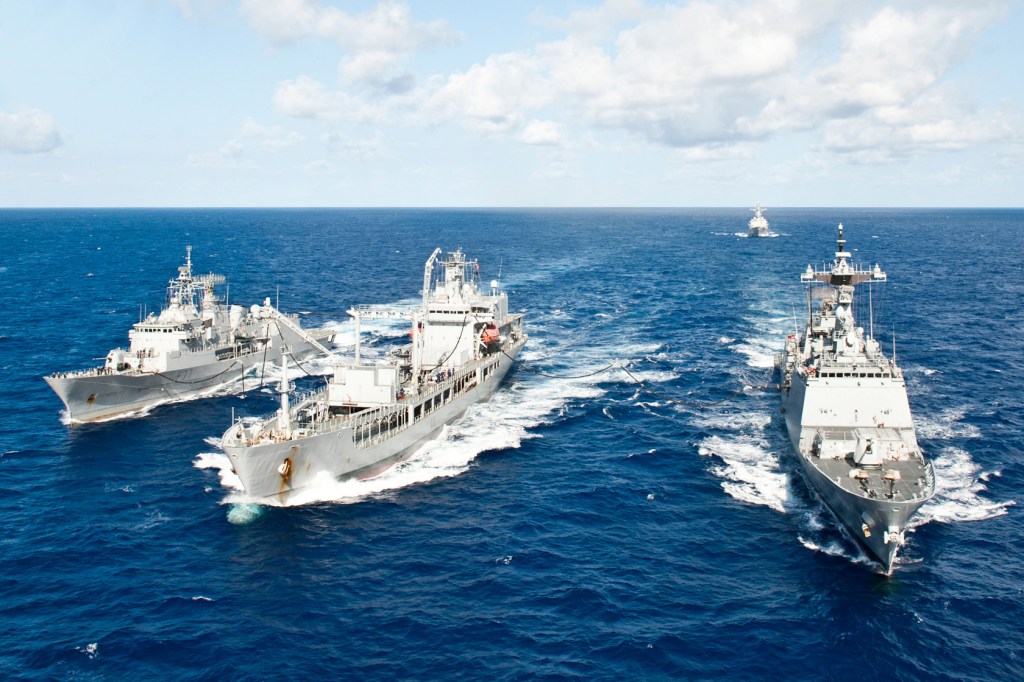
If a country wants to shape its geopolitical interests to reflect those of itself and its allies, it needs to be a major naval power or a significant contributor to a naval coalition. All five permanent members of the United Nations Security Council are major maritime powers. Their ability to use the seas is vital for countries with global interests and status. Throughout history, the capacity to use the sea has been of strategic importance. In an increasingly globalized world order, ships are still at the heart of global trade.
According to the British Naval Doctrine, the three roles of naval forces are depicted as a triangle. At the bottom, it is stated that it is the military/combat capability that makes a navy that supports the whole structure more than just coast guard. This is underestimated in a globalized world order, but events such as the rise of China, the war between Russia and Ukraine, Israel and Palestine show that the importance of combat capability is still critical. The other side of the triangle represents “international engagement”. Naval forces have a capacity for what the British call “balance”. It keeps its options open by remaining in international waters but within range of air or amphibious intervention. The final part of the triangle is policing missions, where navies combine with the coast guard to combat piracy and the misuse of the oceans’ natural resources. This is one side of the triangle where small and medium-sized powers can make the principles of maritime power felt. It is of interest to small and medium-sized powers because most of them can only afford maritime police forces and specialized coast guard personnel. (Grove, 2014)
The East China Sea is one of the world’s most important and strategic maritime transportation routes. It is the arm of the Pacific Ocean encircling the East Asian mainland and extending northeastward from the South China Sea, where it is connected by the shallow Taiwan Strait between Taiwan and mainland China. The East China Sea and the South China Sea together form the China Sea. It extends eastward to the Ryukyu Islands; northward to Kyushu, the southernmost of Japan’s main islands; northwestward to Cheju Island off the coast of South Korea, and thus westward to China, roughly from Cheju Island to the mouth of the Yangtze River (Chiang Jiang) on China’s east coast. (LaFond, 2024)
In terms of location, it includes a geographical environment where two countries such as China and Japan, which have importance in many areas, also claim rights. The claimed islands are the Senkaku\ Diaoyu Islands and they are emerging as a dispute. In addition to having many strategic importance, the East China Sea also concerns other countries that are not located in it. For example, it indirectly involves the US, Japan’s ally in East Asia. (KÜÇÜKDEĞİRMENCİ, 2021)
The main issue in the East China Sea is the question of sovereignty over the islands that China calls “Diaoyu” and Japan calls “Senkaku”. While the control of the islands had been under the control of China for several centuries, the control of the islands was transferred to Japan with the Sino-Japanese war of 1884-1895 and the subsequent Treaty of Shimonoseki signed on April 17, 1895. After Japan’s defeat in the Second World War, the control of the islands was transferred to the United States in the United States-Japan San Francisco Peace Treaty signed in 1951. (Rafiq Dossani, 2016) In 1972, control of the islands was transferred back to Japan from the United States under the Okinawa Repatriation Treaty of 1971. During this period, the People’s Republic of China objected to this situation together with Taiwan, which had similar claims over the islands. However, the issue resurfaced in 1996 when the Japanese Youth Federation, a Japanese nationalist organization, decided to maintain and repair the lighthouse erected on the islands in 1978. This led to large-scale anti-Japan demonstrations in China, Taiwan and Hong Kong (Yukio, 2012).
In conclusion, the East China Sea dispute is broadly defined as the unresolved sovereignty claims between China and Japan over the Diaoyu\Senkaku islands. Both countries have historical claims. In addition to the sovereignty claims over the Diaoyu\Senkaku islands between the two giant economies and powers of Asia, the prominent issues in terms of natural resources are the hydrocarbon reserves such as oil and natural gas that exist and are claimed to exist in the region and the value of the region in terms of fish diversity and fishing industry. (KÜÇÜKDEĞİRMENCİ, 2021)
The East China Sea is of significant value not only for China and Japan, but also for the United States in security calculations. The security agreements between the US and its Asian ally Japan also complicate the situation for China. At the same time, the interests in the region have led to a rivalry between the US and China.
- Atay, S. O. (2016). GEOPOLITICS IMPORTANCE OF THE SEA POWER IN TERMS OF FOREIGN POLICY. Balkan Journal Of Social Sciences, 103.
- Grove, E. (2014). The Ever-Increasing Importance of Sea. ISN .
- KÜÇÜKDEĞİRMENCİ, O. (2021). ÇİN VE JAPONYA’NIN DOĞU ÇİN DENİZİ İHTİLAFI ÜZERİNE BİR. ARHUSS .
- LaFond, E. C. (2024, February 4). https://www.britannica.com. Britannica: https://www.britannica.com/place/East-China-Sea
- Rafiq Dossani, S. W. (2016). Maritime Issues in the East and South China Seas. RAND Corporation’s Center for Asia Pacific Policy.
- U.S.-China Strategic Competition in South and East China Seas: Background and Issues for Congress. (2023). Congressional Research Service1 https://doi.org/https://crsreports.congress.gov/product/pdf/R/R42784
- Yukio. (2012). Barren Senkaku Nationalism and China-Japan Conflict. The Asia-Pacific Journal , 1-7.
- Mahan, A. T. (1890). The Influence of Sea Power upon History.
- LCDR Brian P. O’Lavin, U. (2009). MAHAN AND CORBETT ON MARITIME STRATEGY.

Leave a comment