
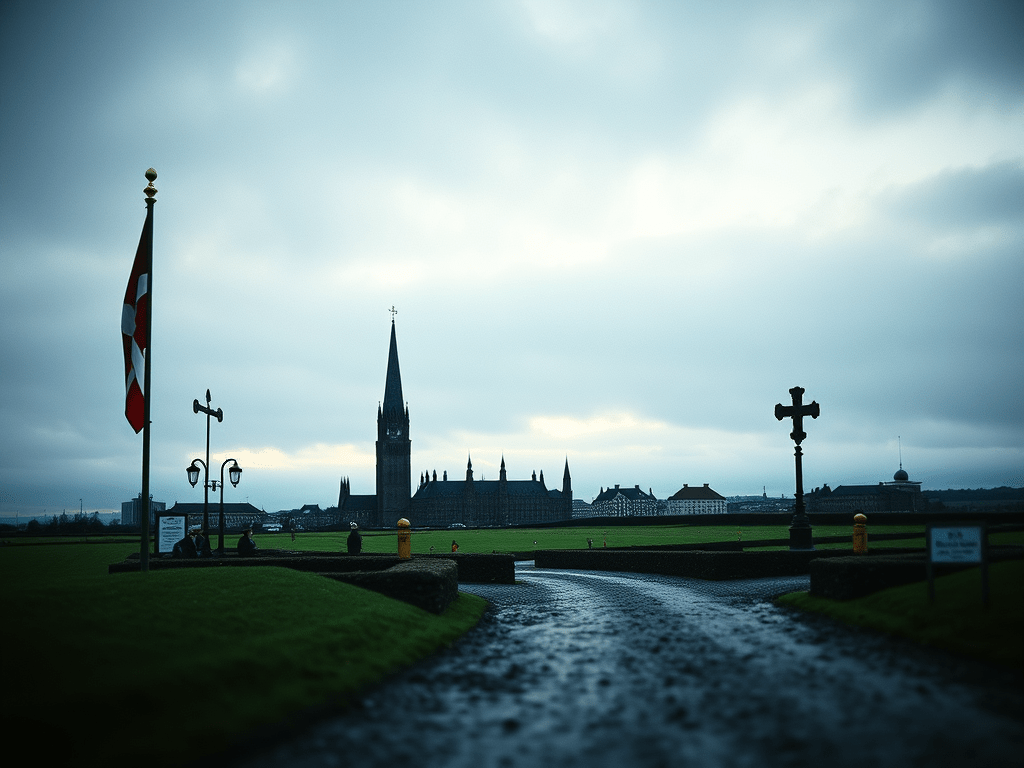
In historical terms, the Northern Ireland problem dates to the 17th century. This problem begins with the settlement of Protestants in the northern part of the region by the United Kingdom (UK) in the 17th century, by providing political superiority to the Catholic people in Ireland. However, in its true sense, the beginning of the Northern Ireland problem begins with the Irish who fought an armed struggle against the discrimination and oppression of the UK until World War II. The Irish, who were in this struggle, made peace initiatives in 1921. As a result of these initiatives, the Free Republic of Ireland was established, although they expressed their own wishes. However, since the majority of Northern Ireland’s population consists of Protestants, it remained with the UK. Catholics, who were in the minority against Protestants, defended the free Irish republic. While the Republic of Ireland was officially established in 1949, the authority of the UK ended. In this process, Northern Ireland has been divided into two different poles. This problem has continued as ethnic, economic, social, and political problems between the Protestants, who are the majority of Northern Ireland, and the Catholics who defend the Irish Republic. (Jarman, 2016)
In June 2016, a referendum was held due to the UK leaving the European Union (EU). In the UK, the public voted to leave with a majority of 51.9%. In addition, in 2017, the withdrawal process started in accordance with the Lisbon Treaty. Looking at the referendum in more detail, Northern Ireland and Scotland were among the countries that voted to remain in the EU. Compared to Scotland, it can be said that Northern Ireland was much more affected by this process. The biggest reason for this is the fact that Northern Ireland is the only region that has a land border with the Republic of Ireland. The public had not very positive thoughts about the path Northern Ireland would follow outside the EU. The importance of Northern Ireland both for the UK’s departure from the EU and for negotiations over its future relationship with the EU depends on Northern Ireland’s history. It arises from Northern Ireland’s ethnic, sectarian, and socioeconomic background, as well as its influence on the EU’s current politics. With Brexit, the possibility of border control in the UK has come to the fore again, as have the previous violent acts of independence led by the Irish Republican Army, which made the unification of the two Irelands a target. The possibility of obstructing the free movement of persons and goods between Northern Ireland and the Republic of Ireland has raised many questions. While there are concerns about the sustainability of the Good Friday Agreement, the development of new policies and mechanisms in terms of maintaining stability and regional peace within the borders of the UK is targeted. However, Brexit has profound political and social consequences for Northern Ireland, given its location as part of the UK, which shares a common border with the EU-member Republic of Ireland. Important results regarding the political and social effects of Brexit in Northern Ireland are given below.
1- Political Reflections
One of the most important effects of Brexit is its political effects. With the emergence of Brexit, changes have been made in the political structure of Northern Ireland and it is predicted that they will be made. The Good Friday Agreement, the Northern Ireland Protocol and the changes and impasses in politics have emerged as the political effects of Brexit.
- Impact on the Good Friday Agreement
Brexit weakens the political and institutional framework of the Good Friday Agreement. However, it has a negative impact on the politics of Northern Ireland because it weakens power sharing. The Good Friday Agreement, also known as the Belfast Agreement, is an agreement aimed at ending the conflicts in Northern Ireland and establishing a peace process. The success of the GFA is largely due to a land border that has lost its political character. With Brexit, the land border problem has resurfaced. According to radical unionists and Nationalists, the land border needs to be strengthened, while moderate nationalists are alienated and disrupting the economy. In general, this agreement, along with Brexit, brings potential obstacles between Northern Ireland and the Republic of Ireland, as it is based on open borders and inter-communal cooperation politically forced. (Biskup)
- The Northern Ireland Protocol
It is known that the issue of open border trade was one of the most challenging parts of the Brexit negotiations when the UK left the EU, meaning that it was part of the Brexit withdrawal agreement. Former Prime Minister Boris Johnson said that Northern Ireland would be interested in eliminating the need for a border with Ireland and to prevent the uncontrolled passage of goods into the EU’s single market, it accepted the proposal to leave Northern Ireland in the EU’s single market for goods. As Northern Ireland is part of the UK’S customs territory, it forms a maritime customs border with Britain. In addition, pro-British communities in the state share their opinions that their place in the UK is being eroded. Unionist parties, especially the Democratic Unionist Party, argue that it threatens Northern Ireland’s place in the UK and oppose the protocol. On the other hand, nationalist parties have decided to support this protocol if it is compatible with their long-term goals of reunification of Ireland, the exact opposite of unionist oppositions. In general terms, opinion polls show that most Northern Irish voters who oppose Brexit support the Northern Ireland protocol. (Reuters, 2023)
- Shifts in Political Power and Political Deadlock
While Brexit has changed the balance of political power in Northern Ireland, it has also led to a political stalemate. During the twenty years of peace, there has been a succession of terrorist activities, a symptom of latent insurgency. As the date of the Scottish Referendum in 2014 approached, opposition Republicans launched numerous attacks, many of them fatal. Along the roads we passed, bomb attacks were carried out against security forces, especially the police. Post-Brexit Irish Republicans have historically had strong political power in Northern Ireland. With the disagreements over the consequences of Brexit and the negativities in the Northern Ireland Protocol, the Northern Ireland Assembly has been suspended many times. As a result, this situation affected public services and management.
2- Social Reflections
In addition to the political effects of Brexit in Northern Ireland, its social effects are also equally important. There have been some situations that threaten the public, such as the identity of the people, the harmony of the people with each other, public problems, and economic problems.
- Identity and Community Relations
Identity issues for the people of Northern Ireland are seen as another problem that emerged after Brexit. Although the regulations on the functioning of EU law were eliminated with Brexit, EU law also had an important place in the protection of constitutional regulations and human rights for Northern Ireland. The Irish border has various meanings for Northern Ireland, both symbolically and symbolically. In concrete terms, the Irish Border is at the center of Northern Ireland’s constitutional arguments in terms of civil rights and justice, and in symbolic terms. Along with all this, the relative absence of borders and the existing soybeans have a very important place for identity. In general terms, this new border resulting from Brexit is an indication that both parts of the island now have a different future.
- Social Cohesion and Public Sentiment
Socially, Brexit has also affected public sentiment and social cohesion. It has also left long-term or short-term effects on the welfare level of the country and the personal health of the people. The people of Northern Ireland, who have experienced political uncertainty for a long time, have also experienced economic stress, and this has become a personal problem for mental health. Anxiety and disappointment for the public also brought about social disharmony. In 2016, when the referendum was held, most of the Irish people, with a population of approximately 1 million, voted to remain in the EU, but the referendum result caused the next generation and young people to feel anxious and disappointed about the future.
- Economic Challenges and Public Services
With Brexit, Northern Ireland has had to experience economic change. Northern Ireland’s economy is known to be largely dependent on public sector spending financed by UK government grants. For a country with a dependent economy, the people of Northern Ireland faced a negative situation with economic uncertainty following Brexit and then an economic decline. Since these economic difficulties also cause social unrest, it would be more accurate to examine Brexit under the Social reflections. More concretely, protests and strikes occurred within the country after Brexit. With the deterioration of working conditions and the delay in salary increases, protests were organized by the public. The issue generally discussed in protests and strikes is the improvement of public services and the improvement of wages.
Conclusion
Northern Ireland has started a new era with Brexit. Although most of the people of Northern Ireland voted to remain in the EU in the referendum held in June 2016, the United Kingdom officially left the EU with the majority vote and entered a new era with Brexit. The Northern Ireland issue, which has a long history, has not been very effective in the long term with Brexit, while the EU has provided peace and security with agreements to help solve its ethnic, social, economic, and political problems within the country. Northern Ireland is the country most affected by Brexit among the UK countries. The biggest reason for this is that it has a border with the Republic of Ireland. The border between Northern Ireland and the Republic of Ireland is seen as a major concern. With Brexit, it can be seen as a border that could disrupt trade and the Good Friday Agreement. In this case, Northern Ireland, which has experienced many negativities after leaving the EU, has also experienced political and social effects. The Good Friday Agreement, which brought peace and security to the country in political terms, reduced the impact of the Northern Ireland Protocol and caused shifts and deadlocks in the political structure. In addition, Brexit, which has had social effects, has increased economic difficulties, experienced difficulties in public services, uncertainty about identity and left the public in general uncertainty. As a result, the type of relationship that the UK will establish with the EU in the post-Brexit period will significantly affect Northern Ireland and will be of vital importance in ensuring the protection of Northern Ireland’s interests in this process and in continuing the peace process with them.
- Jarman, N. (2016). The Challenge of Peace Building and Conflict Transformation: A Case Study of Northern Ireland . Kyiv-Mohyla Law and Politics Journal.
- Biskup, D. P. (n.d.). The long-term implications of Brexit for Northern Ireland. European Policy Centre.
- Reuters. (2023, February 26). Retrieved from https://www.reuters.com/world/uk/talks-post-brexit-northern-ireland-trade-edge-closer-deal-2023-02-20/
- Wright, N. (2021). Brexit and Beyond. UCL Press.
- Cathy Gormley-Heenan, A. A. (2017). Waking up in a different country: Brexit and Northern Ireland. ARK.
- Çağdaş CENGİZ, E. K. (2021). İRLANDA SORUNU’NUN TARİHSEL KÖKLERİ VE BREXIT SONRASI İRLANDA SORUNU: BİRLEŞİK BİR KRALLIK MI, BİRLEŞİK BİR İRLANDA MI? IJOESS.
- Elif Dilan TÜTMEZ, E. K. (2024). Transformation of Security in Northern Ireland and the EU Relations after Brexit: Revived Historical Problems. International Journal of Economics and Innovation.
- POGATCHNIK, S. (2024, January 19). POLITICO. Retrieved from https://www.politico.eu/article/no-government-elections-more-m
- oney-northern-ireland-belfast-crisis-inflation-pay-rise-protests/
- CFR. (2019, December 17). Retrieved from https://www.cfr.org/conference-calls/brexit-and-future-northern-ireland
- Fleming, A. (2021, April 9). BBC. Retrieved from https://www.bbc.com/news/uk-politics-56678489

Leave a comment